

أَلَمۡ نَجۡعَلِ ٱلۡأَرۡضَ مِهَٰدٗا وَٱلۡجِبَالَ أَوۡتَادٗا
Have We not made the earth a resting place And the mountains as stakes
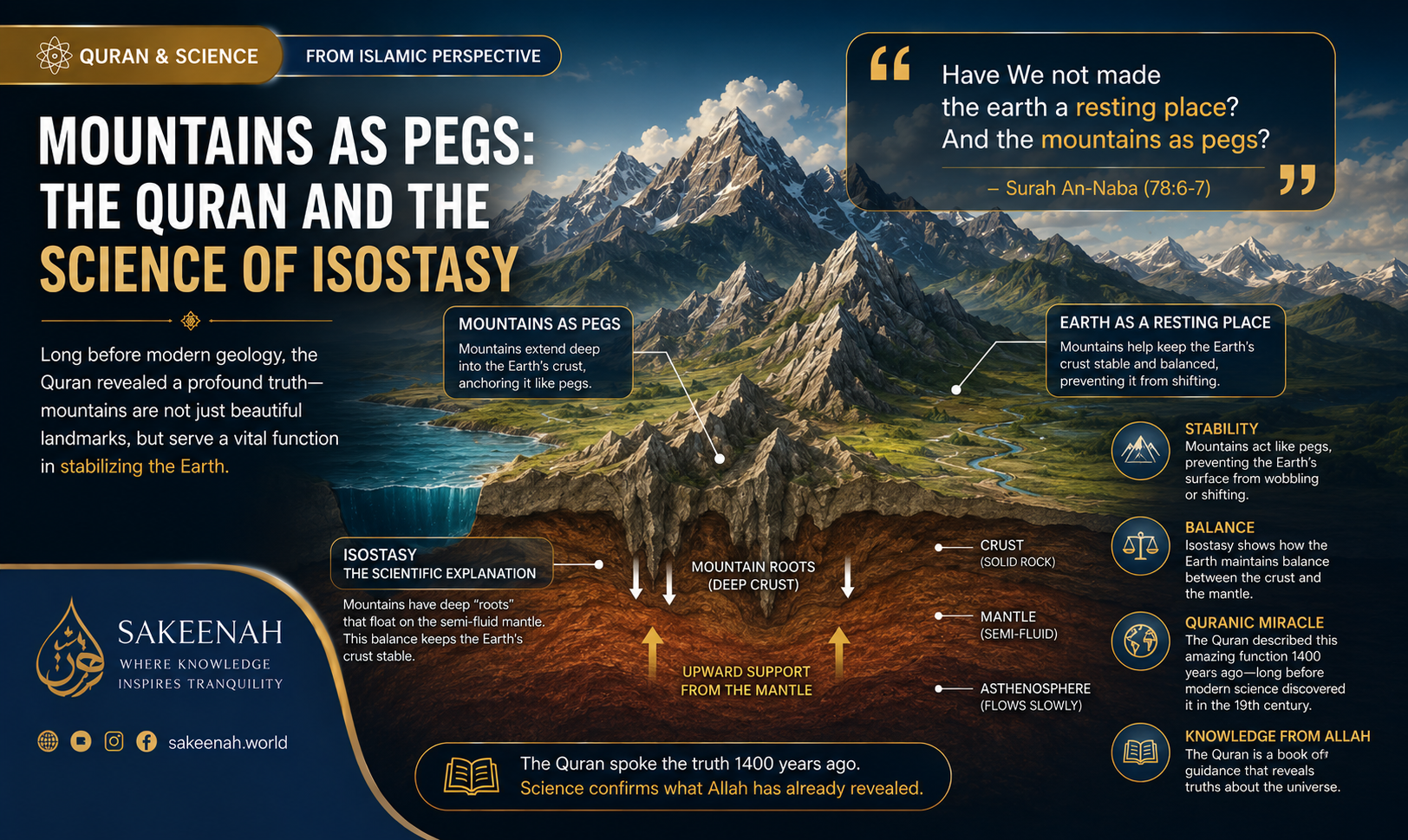
The verses read in Arabic: أَلَمْ نَجْعَلِ الْأَرْضَ مِهَادًا وَالْجِبَالَ أَوْتَادًا. In transliteration: Alam najAAali al-arda mihadan waal-jibala awtadan. The translation: "Have We not made the earth a resting place? And the mountains as pegs?" The word mihaad means a cradle or resting place, suggesting stability and ease of settlement for living beings. The word awtad is the crucial term here: it means pegs, stakes, or tent-pegs — objects that are driven into the ground and which have a long portion beneath the surface that secures whatever structure they support.
A tent-peg visible above ground is only a small fraction of its total length; its securing function depends entirely on what lies below. This single metaphor — mountains as pegs — contains within it a claim about geological structure that the naked eye cannot perceive: that the visible mountain above the earth's surface is only part of its total extent, and that it extends downward into the earth as a stabilising anchor.
Ibn Kathir, in Tafsir Ibn Kathir, interprets these verses as evidence of Allah's grace in making the earth stable and inhabitable. He comments that the mountains serve as stabilisers for the earth, preventing it from moving or tilting in ways that would make it uninhabitable. He cites the parallel verse in Surah An-Nahl (16:15): "And He has cast into the earth firmly set mountains, lest it shift with you" — reinforcing the geological and functional purpose of mountains as anchors for the earth's surface.
Al-Tabari, in Jami al-Bayan, similarly explains awtad as pegs that penetrate into the earth and secure it, noting that the metaphor of the peg implies depth below the surface. These classical scholars, writing without geological knowledge, faithfully transmitted the verse's implication that mountains are not simply surface features but structures whose function depends on what lies beneath them — a reading that geology would later confirm in precise technical terms.
The geological principle that explains the Quranic metaphor is called isostasy, a concept formulated in the nineteenth century by British geodesist George Airy in 1855. Airy proposed that mountains are not simply masses sitting on the surface of the Earth's crust; they are compensated by deep roots of less-dense crustal material extending down into the denser mantle beneath. Just as an iceberg floats with the majority of its mass below the waterline, mountains have deep roots that push down into the mantle in proportion to their height.
This principle, confirmed and refined through seismic studies throughout the twentieth century, is now a foundational concept in plate tectonics and geophysics. The roots of the Himalayan mountain range, for example, extend approximately sixty to seventy kilometres into the Earth's mantle. The Andes, the Alps, and the Atlas Mountains all have analogous deep roots. These roots serve a functional purpose: they provide isostatic equilibrium, meaning that the mass of the mountain above the surface is balanced by the buoyancy of the root below, stabilising the crust against vertical displacement.
The correspondence between the Quranic term awtad and the geological reality of mountain roots is striking on multiple levels. A tent-peg's function is precisely to anchor through extension below the surface — the visible portion above ground is secondary to the buried portion that provides stability. Modern geology has confirmed that this is exactly how mountains work: their stabilising function operates primarily through their underground roots. The verse also connects mountains to the stability of the earth as a whole: mihaad (a cradle or resting place) suggests that the earth's habitability is linked to the function of mountains.
Plate tectonic theory confirms this connection — mountain-building processes are integral to the stability of continental plates, and the deep roots of mountains are part of the crust's structural equilibrium. The Quran's choice of metaphor — pegs rather than pillars, walls, or columns — is therefore geologically more accurate than any of those alternatives would have been.
Fair intellectual assessment requires acknowledging the limits of this comparison. The verse does not describe seismic activity, plate tectonics, or mantle composition in technical terms. The peg metaphor is a descriptive image, not a scientific formula. Some scholars of Islamic epistemology point out that the word awtad was a natural metaphor available to any Arab living in a tent-dwelling culture, and that applying it to mountains may have been intuitive rather than divinely guided.
This objection has merit as a methodological caution. However, the specific claim embedded in the metaphor — that mountains have a deep structural component below the surface that provides their anchoring function — was not obvious to ancient geologists or philosophers. Greek and Roman geographical thinking treated mountains primarily as surface features. The Quranic choice of the peg metaphor, with its specific implication of subsurface depth, aligns with what geology discovered only in the modern era, making the correspondence more than merely coincidental.
For the believer, this verse is among the most elegant demonstrations of what the Quran calls its ayat — signs. The earth beneath our feet is not simply a passive platform; it is an engineered structure in which mountains serve as dynamic anchors, maintaining the balance of the crust through roots that penetrate deep into the mantle. The cradle metaphor for the earth, paired with the peg metaphor for mountains, describes a relationship of stability and care: the earth was made habitable, and mountains were placed as the mechanisms of that habitability.
When a Muslim stands before a mountain range and contemplates the verses of Surah An-Naba, the invitation is to see the geological structure not merely as the product of tectonic forces acting over billions of years, but as a designed system in which those very forces are the instruments of divine wisdom. The mountain's hidden root, invisible to the eye, becomes a symbol of the Quran's own structure: much of its depth lies beneath the surface, available only to those who seek it.
العلم يتغير كلما ازدادت المعرفة، والقرآن كتاب هداية لا كتاب علوم. نقدّم هذه التأملات للحث على التفكر في آيات الله في الخلق.