

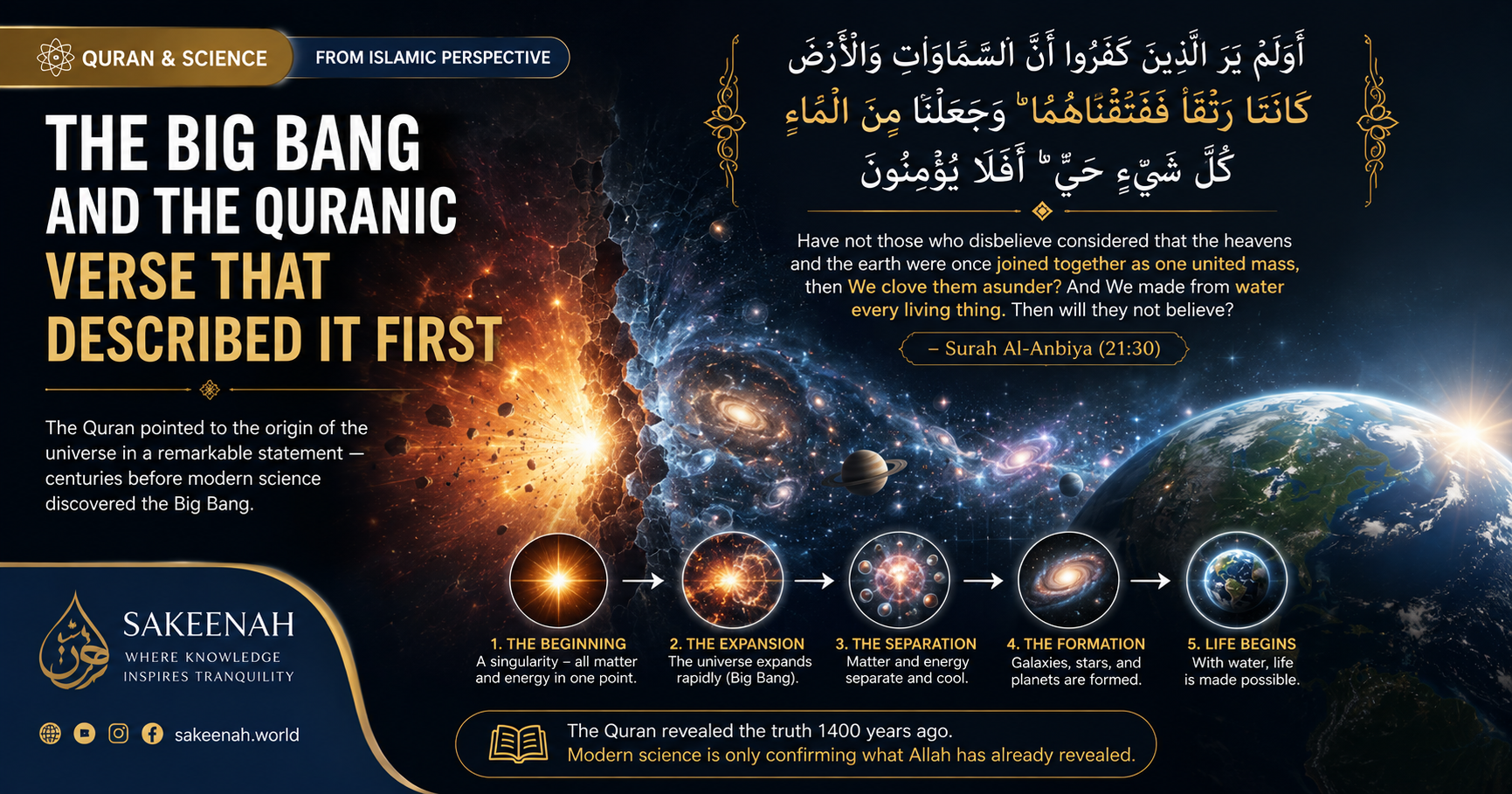
أَوَلَمۡ يَرَ ٱلَّذِينَ كَفَرُوٓاْ أَنَّ ٱلسَّمَٰوَٰتِ وَٱلۡأَرۡضَ كَانَتَا رَتۡقٗا فَفَتَقۡنَٰهُمَاۖ وَجَعَلۡنَا مِنَ ٱلۡمَآءِ كُلَّ شَيۡءٍ حَيٍّۚ أَفَلَا يُؤۡمِنُونَ
Have those who disbelieved not considered that the heavens and the earth were a joined entity, and We separated them and made from water every living thing? Then will they not believe
The verse in question reads in Arabic: أَوَلَمْ يَرَ الَّذِينَ كَفَرُوا أَنَّ السَّمَاوَاتِ وَالْأَرْضَ كَانَتَا رَتْقًا فَفَتَقْنَاهُمَا وَجَعَلْنَا مِنَ الْمَاءِ كُلَّ شَيْءٍ حَيٍّ أَفَلَا يُؤْمِنُونَ. Its transliteration reads: Awa lam yara allatheena kafaroo anna alssamawati waal-arda kanata ratqan fafataqnahuma wajaalna mina almai kulla shayin hayyin afala yuminoon. The translation, as rendered by scholars of tafsir, is: "Have those who disbelieved not considered that the heavens and the earth were a joined entity, and We separated them and made from water every living thing? Then will they not believe?"
The two key Arabic words are ratqan, meaning a closed, fused, or stitched-together mass, and fataqnahuma, meaning We split or tore them apart. These terms describe a primordial state of unity followed by a divine act of separation — a cosmological claim of extraordinary specificity for a text revealed in the seventh century CE.
Ibn Kathir, in his monumental Tafsir Ibn Kathir, comments on this verse by noting that the heavens and the earth were originally stuck together as one, and that Allah then separated them. He cites the narrations of Ibn Abbas (may Allah be pleased with him), who explained that the sky was not sending down rain and the earth was not producing vegetation until they were separated by Allah's command. Ibn Kathir links this to the broader theme of divine power over creation, emphasising that the very cohesion and then separation of the cosmos is a sign (ayah) pointing rational minds toward the Creator.
Al-Tabari, in his Jami al-Bayan, similarly records that the classical interpreters understood ratq to mean joined together without a gap, and that the fatq — the splitting — resulted in the emergence of the heavens as separate from the earth. Al-Tabari's compilation preserves the view that this refers to a real cosmological event, not merely a metaphor for the distinction between sky and land as we observe them today. These scholars wrote without knowledge of modern physics, yet their exegesis aligned with a literal and primordial separation of heavens and earth.
The Big Bang theory, now the scientific consensus on the origin of the universe, was formally developed in the twentieth century. Belgian priest and physicist Georges Lemaître proposed in 1927 that an expanding universe implied an original point of infinite density, which he called the "primeval atom." Edwin Hubble confirmed in 1929 that galaxies are receding from one another, lending observational support to this model. The definitive confirmation came in 1964 when Arno Penzias and Robert Wilson of Bell Laboratories accidentally discovered the Cosmic Microwave Background radiation — the thermal afterglow of the initial explosion — a finding for which they received the 1978 Nobel Prize in Physics.
According to the standard cosmological model, all of the matter and energy of the observable universe was once contained in a singularity of near-infinite temperature and density. Approximately 13.8 billion years ago, this singularity began expanding rapidly. In the earliest moments, the universe was indeed a ratq — a fused, indistinct whole — before differentiation, cooling, and the emergence of distinct structures including stars, galaxies, and eventually the Earth itself.
The connection between Surah Al-Anbiya 21:30 and the Big Bang theory is one of the most frequently cited examples of Quranic scientific correspondence, and for good reason. The Arabic terms ratq and fatq carry cosmological weight: ratq implies a state of complete fusion with no separation, while fatq implies a sudden, decisive rupture. The verse does not merely describe a general separation of sky and earth as observable phenomena; it frames this as a primordial event that preceded the current state of the cosmos.
The additional phrase — that every living thing was made from water — adds another layer of scientific resonance, as modern biology confirms that liquid water is essential to all life and that the earliest life forms emerged from aquatic environments. The verse's framing, directed at those who disbelieve, suggests it was intended as a rational argument from observable and historical reality, which is precisely how cosmologists frame the Big Bang: as an inference from evidence.
Intellectual honesty requires acknowledging the limits of this comparison. The verse does not specify a timeline, a mechanism of inflation, or the quantum physics of the early universe. Classical scholars had no concept of cosmological expansion or background radiation, and their interpretations of the verse were shaped by the knowledge available to them. The connection is thematic and linguistically suggestive rather than a precise technical match. Some contemporary scholars of Islamic epistemology, such as Seyyed Hossein Nasr, caution against reading modern science into Quranic verses retroactively, arguing that the Quran is primarily a book of guidance rather than a textbook of physics.
This caution is valid and worth preserving. The strength of the connection lies not in claiming the Quran predicted the Big Bang with scientific precision, but in recognising that the language of the verse — a fused cosmos, then a tearing apart — describes the correct general picture of cosmic origins without any of the mythological alternatives, such as the universe emerging from an egg or from the body of a slain god, that characterised other ancient cosmogonies.
For the believer, this verse is an invitation to deep reflection. The Quran was revealed to an unlettered prophet in a society with no telescopes, no particle accelerators, and no tradition of mathematical cosmology. Yet the verse describes the universe's origin in terms that align, at least thematically and linguistically, with what humanity would not discover for another fourteen centuries. This alignment invites the question: if the Author of the Quran is the Creator of the cosmos, then the congruence between the Book and the universe is not merely coincidental but intrinsic.
The cosmos and the Quran are both signs — ayat — pointing to the same source. Ibn Kathir ended his commentary on this verse by noting the phrase: "Then will they not believe?" — a rhetorical question directed at those who see the evidence and yet turn away. In every age, the signs are present; what varies is the depth of the gaze brought to them.
العلم يتغير كلما ازدادت المعرفة، والقرآن كتاب هداية لا كتاب علوم. نقدّم هذه التأملات للحث على التفكر في آيات الله في الخلق.