

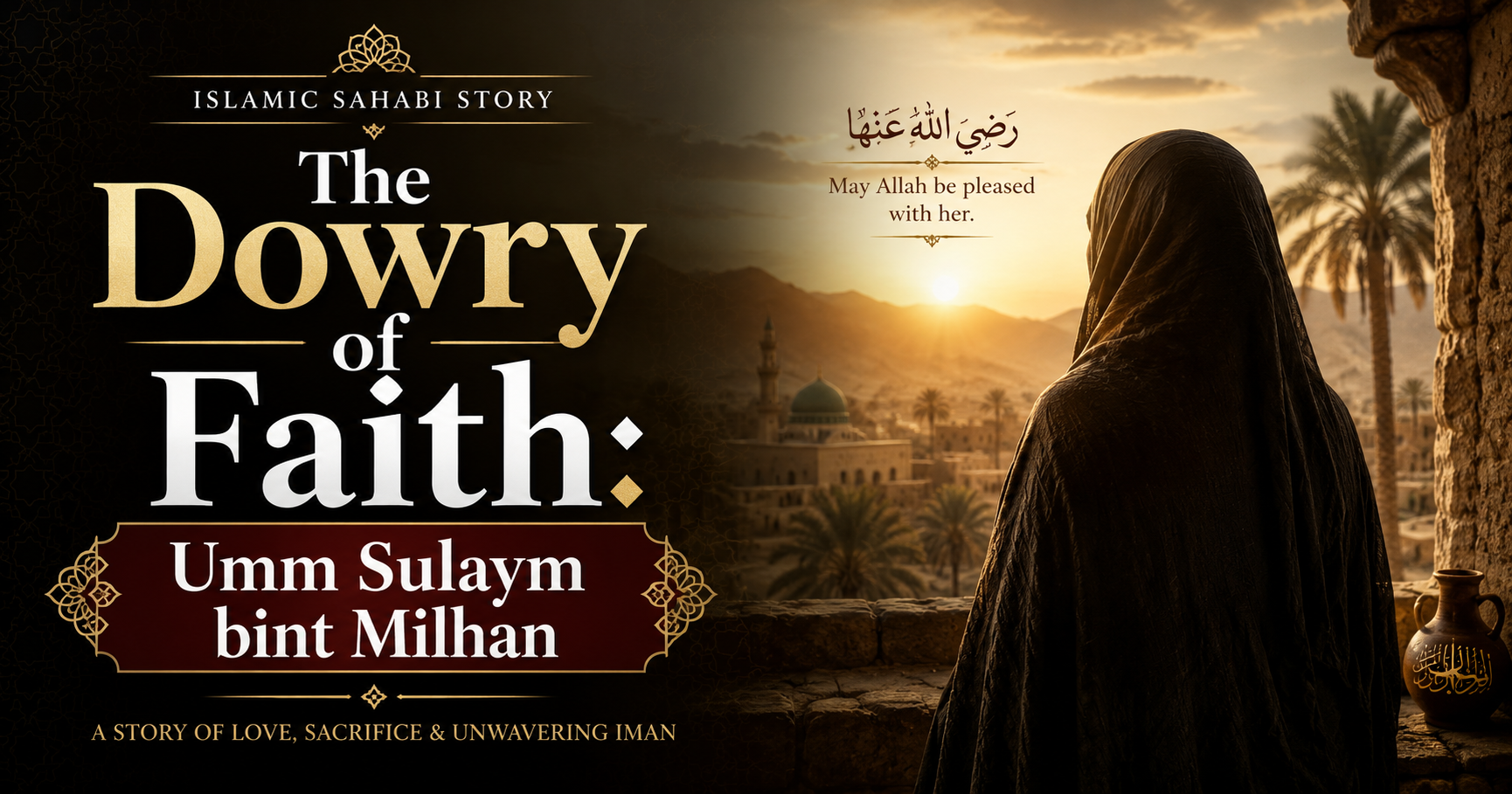
Umm Sulaym bint Milhan (Al-Rumaysa/Al-Ghumaysa)
Umm Sulaym was an early Ansari believer of Medina who made her acceptance of Islam the entire dowry for her marriage, and the mother of Anas ibn Malik, the Prophet's ﷺ young servant. She is remembered in the hadith literature for a self-control so profound that the Prophet ﷺ himself marveled at it.
Early Medinan Period · Circa 580–650 CE
The house in Medina was quiet except for the sound of a woman preparing a bed, smoothing a cloth, and setting food gently near the door, as though nothing at all was wrong. Umm Sulaym bint Milhan moved through her home with the same steady hands she always had, even though her young son had died only hours before. Her husband, Abu Talha, had been away, and she had made a decision that would become one of the most quoted examples of sabr, patience, in Islamic history: she would not tell him yet.
Before this moment, Umm Sulaym was already known among the Ansar of Medina as a woman of unusual conviction. Ibn Sa'd records in his Tabaqat that when she embraced Islam, her husband at the time, Malik ibn al-Nadr, rejected her new faith and eventually left Medina, later dying while still outside the fold of Islam. She was left a widow with her young son, Anas. When Abu Talha, a respected and still-unconverted Ansari, proposed marriage to her and offered a substantial dowry of gold and silver, she gave an answer that startled him: she did not want his wealth.
She told him that as a Muslim, it was not lawful for her to marry a man who worshipped idols, but that if he accepted Islam, his acceptance of the faith would be dowry enough for her. Abu Talha, moved by her firmness, pronounced the shahada that same day, and their marriage became one of the few in history where the bride price was a man's entire soul redirected toward God.
From that union came Anas ibn Malik, whom Umm Sulaym brought to the Prophet ﷺ as a young boy, saying, O Messenger of Allah, here is Anas, your little servant. He served the Prophet ﷺ for ten years and later transmitted more than two thousand hadith, becoming one of the great narrators of Islamic knowledge, a legacy that began with his mother's decision to place him in prophetic company.
Umm Sulaym did not remain in the background of Medina's history. She was present at the Battle of Uhud, one of several women who moved among the wounded carrying water skins on their backs, as recorded in Sahih al-Bukhari, where Anas himself narrates having seen his mother and Umm Sulaym's companion Umm Sulait running back and forth to tend to fighters despite the danger. At the Battle of Hunayn, according to reports preserved by Muslim, she carried a dagger tucked into her waist.
When Abu Talha asked her what it was for, she answered plainly that if any disbeliever came near her, she would use it to open his stomach, a statement that reveals a woman who had fully internalized the seriousness of the moment the Ummah was living through.
The episode for which she is most remembered, however, is the death of her infant son with Abu Talha. The child fell ill and died while Abu Talha was away tending the date palms. Rather than announce the loss immediately, Umm Sulaym washed the child, prepared him for burial with the help of her family, and kept the household calm. When Abu Talha returned and asked about the boy, she told him he was quieter than usual, and served him dinner as she always did.
Only after he had eaten and rested did she gently ask him a question recorded in Sahih Muslim: if a family lent something to their neighbors and the neighbors later asked for it back, would it be right for the family to refuse to return it? Abu Talha said no, of course not. She then told him that their son had been a loan from Allah, and Allah had reclaimed what was His.
Abu Talha, understanding, went to the Prophet ﷺ and informed him of what had happened. The Prophet ﷺ, astonished at her composure, prayed for the couple, saying, May Allah bless the night you spent together. That very night, Umm Sulaym conceived, and the child born from it was named Abdullah, who would go on to have ten sons, nine of whom became reciters and scholars of the Quran, a lineage of knowledge that flowed directly from her patience.
Umm Sulaym's legacy did not end with her household. She became known as a woman the Prophet ﷺ visited personally and trusted deeply; he would rest at her home and she would collect strands of his blessed hair from his comb to keep as a source of blessing, a practice mentioned in Sahih Muslim. Scholars have long pointed to her as a model for how ordinary faith, expressed through daily choices rather than grand gestures, can shape generations. Her son Anas carried Prophetic knowledge to the next century; her descendants carried the Quran; and her own name became shorthand among the Companions for what true reliance upon Allah during loss actually looks like.
The enduring lesson of Umm Sulaym's life is that steadfastness is not the absence of grief but the disciplined choice of how and when to carry it. She grieved her son, but she chose the moment, the words, and the composure with which she delivered the news, protecting her husband from a shock that might have overwhelmed him in an unprepared state. In an age that often equates strength with the loud expression of every emotion the instant it arises, her story offers a different model: that dignity, timing, and trust in Allah's decree can themselves be forms of profound emotional intelligence and faith.
دروس من هذه القصة
- True wealth in marriage is shared faith and purpose, not material provision; Umm Sulaym rejected a large dowry in favor of a husband who would stand beside her in belief, showing that spiritual compatibility is the foundation worth prioritizing above worldly comfort.
- Patience during loss can be exercised through wisdom in timing and delivery, not merely through silent endurance. Umm Sulaym managed her own grief responsibly so that she could deliver devastating news to her husband in a way that protected his emotional and spiritual state.
- Small acts of devotion compound across generations. Her decision to raise Anas in the Prophet's ﷺ service, and her calm trust in Allah's decree, produced a lineage of scholars and narrators whose impact on Islamic knowledge is still felt today.
العمل به اليوم
For a Muslim today navigating marriage decisions, Umm Sulaym's example is a direct challenge to modern assumptions about what makes a spouse worth choosing. Financial stability and social status are not unimportant, but her story insists that shared commitment to faith and character should never be traded away for wealth or convenience. A practical application is to genuinely evaluate a potential spouse's relationship with Allah, their honesty, and their willingness to grow spiritually, rather than allowing salary figures or family prestige to dominate the decision entirely.
On the matter of grief and hardship, her story offers a concrete template rather than a vague call to be patient. When facing devastating news, whether the loss of a loved one, a job, or a long-held plan, a Muslim can draw on her method: attend to immediate responsibilities first, seek a calm moment rather than reacting in the heat of shock, and frame the loss using language of trust in Allah, remembering that whatever was given was always a loan from Him to be returned.
This does not mean suppressing grief, but rather channeling it through wisdom, prayer, and careful timing so that one's own pain does not become a burden thrust unprepared onto others who depend on emotional steadiness in that moment.