

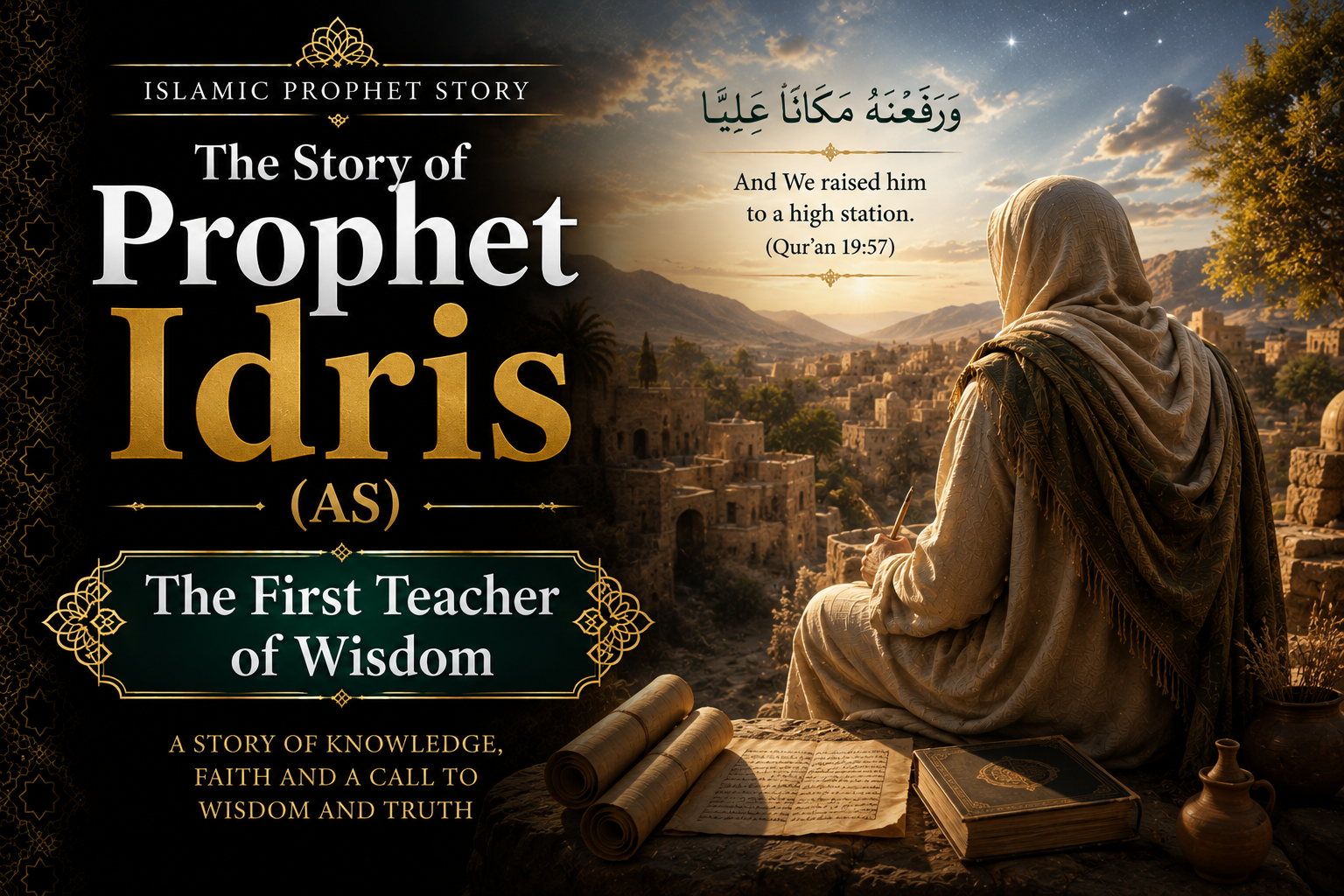
Idris (peace be upon him), identified in classical Islamic tradition with the Prophet Enoch
Prophet Idris (peace be upon him) was one of the earliest messengers of Allah, a descendant of Adam's son Shith, and is honored in the Quran with the rare title of siddiq — one of absolute truthfulness — and the extraordinary distinction of having been raised by Allah to a high station while still in this life. He stands in Islamic tradition as the first human being to write with a pen, the originator of foundational sciences including astronomy and mathematics, and the prophetic model of a man whose every act of learning was inseparable from his devotion to Allah.
Antediluvian Pre-Islamic Prophetic Era, Early Generations After Adam · Circa 3500–3000 BCE (traditional reckoning, antediluvian era)
Picture the world in its earliest centuries — not yet scarred by the flood that would come generations later, not yet divided into the civilizations and kingdoms that would rise and fall across the millennia of recorded history. The descendants of Adam had multiplied, the earth was being settled by communities that still carried within them the living memory of the first man and his covenant with his Lord, and yet already the slow drift had begun — the drift from pure devotion toward the comfortable worship of the visible and the familiar.
Into this young world, still taking its first steps away from its origin, Allah sent a man whose name would become synonymous with knowledge, with writing, and with the elevation of the human intellect in the service of divine awareness. His name was Idris, peace be upon him, and the classical scholars are unanimous that he was among the earliest Prophets after Adam and his son Shith — placed by Ibn Kathir in Al-Bidayah wal-Nihayah as the third Prophet sent to humanity, following Adam and Shith, and receiving his prophetic commission in the generations before Nuh came with his great and devastating mission.
The world into which Idris was sent was not yet destroyed — it was drifting. And drifting worlds need teachers more than they need warnings, because the people in them do not yet know they are lost.
The Quran mentions Idris, peace be upon him, by name in two passages, and both of them are dense with honor. In Surah Maryam (19:56–57), Allah says: 'And mention in the Book, Idris. Indeed, he was a man of truth and a Prophet. And We raised him to a high station.' In Surah Al-Anbiya (21:85–86), he is listed among the Prophets who were patient — alongside Isma'il and Dhul-Kifl — and is described as one whom Allah admitted into His mercy, for he was among the righteous.
Three qualities emerge from these two passages: siddiq, patience, and elevation to a high station. The classical scholars, including al-Qurtubi in his Tafsir and Ibn Kathir in his, treat these three qualities as interconnected rather than sequential — that it was precisely because Idris was a man of absolute truthfulness, and because he maintained that truthfulness with the patience of a man who had never sought human recognition for it, that his elevation became inevitable.
The high station was not a reward appended to a life lived well; it was the natural destination of a soul that had been moving toward its Lord with absolute consistency across an entire lifetime of devotion and teaching.
The classical Islamic historical tradition, preserved most comprehensively by Ibn Kathir in Al-Bidayah wal-Nihayah and drawing on the accumulated scholarship of al-Tabari, al-Qurtubi, and others, credits Idris, peace be upon him, with a series of foundational contributions to human civilization that are presented not as secular achievements but as prophetically motivated gifts to his people. He is identified as the first human being to write with a pen — a detail of enormous significance in a tradition that begins with the revelation of 'Iqra' and honors the pen explicitly in Surah Al-Qalam (68:1) where Allah swears by it.
Before Idris, according to these classical accounts, human knowledge was transmitted only through speech and memory. He introduced the written word as a means of preserving and transmitting what had been received — a gift whose consequences for the preservation of revelation, of history, of science, and of every form of accumulated human understanding across all subsequent millennia cannot be overstated. He is also credited in these accounts with being the first to chart the movements of the stars, to establish the foundational principles of arithmetic, and to introduce the craft of sewing garments from woven cloth rather than wearing animal skins.
Ibn Kathir records these attributions while noting that Allah knows best their precise extent, but the consistent presence of these credits across the classical tradition reflects the Islamic understanding that Idris stood at the origin of the transition from raw human survival to organized, knowledge-transmitting civilization.
The devotion of Idris, peace be upon him, to worship is given specific and remarkable treatment in a hadith narration that Ibn Kathir includes in his discussion, drawing on reports transmitted through the early generations of Islamic scholarship. According to these accounts, Idris was known for a practice of worship so sustained and so intense that it drew the attention of the angelic realm. One narration describes an angel who visited him repeatedly, carried on his wings between the earth and the heavens, in a relationship of spiritual friendship that developed over time.
Ibn Kathir records — with appropriate scholarly caution about the chain of transmission — that the angel expressed wonder at the scale of Idris's worship, and that on one of these visits, Idris asked his angelic companion to carry him to see the Angel of Death, expressing a wish to meet the one who would eventually take his soul. The account describes a meeting in which the Angel of Death expressed surprise, for he had been instructed that Idris's soul was to be taken while Idris was in the fourth heaven — a location the Angel of Death had not yet understood the means of reaching.
It was during this very encounter that Idris's soul was taken, in the fourth heaven, fulfilling the divine decree in a manner that none of its participants had anticipated. Ibn Kathir treats this narration with scholarly reserve while affirming the broader Quranic truth it illustrates: the elevation of Idris was genuine, his station in the fourth heaven was real, and the manner of his passing was a divine decree whose precise logistics belonged entirely to Allah.
The Prophet Muhammad, peace be upon him, encountered Idris, peace be upon him, on the night of the Isra wal-Mi'raj — the night journey and ascension that is recorded in Sahih al-Bukhari and Sahih Muslim in the narrations of Anas ibn Malik and others. As the Prophet, peace be upon him, ascended through the levels of the heavens accompanied by the angel Jibril, he met the Prophets stationed at different levels.
Adam was in the first heaven. Yahya and 'Isa were in the second. Yusuf was in the third. And in the fourth heaven, the Prophet, peace be upon him, met Idris — who greeted him with warmth, acknowledged him as a righteous Prophet and righteous brother, and welcomed him. The placement of Idris in the fourth heaven, at the midpoint of the prophetic hierarchy that the Mi'raj traversed, is a detail that has occupied the classical commentators across centuries.
Al-Qurtubi notes that the fourth heaven in ancient cosmological understanding corresponded to the sphere of the sun — the central luminary, the source of illumination for the visible world — and that the placement of Idris at this level carried a symbolic resonance with his role as the illuminator of early human knowledge. Whether the correspondence is taken literally or figuratively, what the hadith establishes beyond any scholarly dispute is that Idris, peace be upon him, occupied a station of genuine honor in the assembly of the Prophets, recognized by the greatest of all Prophets in the most sacred journey ever undertaken by a human being.
The name 'Idris' itself has drawn the attention of classical Islamic linguists. A significant scholarly opinion, held among others by Ibn Kathir, connects it to the Arabic root darasa — to study, to learn, to read carefully — suggesting that his very name encoded the nature of his prophetic mission. He was the one who studied, the one who taught others to study, the one in whose life the act of learning and the act of worship were not merely compatible but identical.
This linguistic connection is not presented as definitive by the classical scholars, but its resonance with everything else known about Idris makes it a reading that the tradition has consistently found meaningful. Al-Tabari in his Tarikh al-Rusul wal-Muluk describes Idris as having been given thirty suhuf — pages of revelation — from Allah, making him one of the early recipients of divine scripture alongside Adam and Shith before him. These pages, according to the tradition, contained guidance not only about worship and morality but about the created order itself — about the patterns of the stars, the regularities of the natural world, the structures of time — all of it revealed as a unified expression of divine wisdom that Idris was then charged with teaching to his people.
Knowledge and revelation arrived together in his hands as a single gift, because in the understanding of Idris there was never a meaningful distinction between them.
The legacy of Idris, peace be upon him, in Islamic civilization flows through two channels that appear separate but share a common source. The first is the intellectual channel: his identification as the originator of writing, mathematics, and astronomical observation made him a figure of deep significance for the Islamic scholars of the classical era who understood themselves as inheritors of a prophetically consecrated tradition of inquiry. When the scholars of the eighth and ninth centuries CE preserved and expanded the Greek philosophical and scientific legacy, when they built the observatories and wrote the treatises on algebra and optics and medicine that became the foundation of the European Renaissance, they were operating within a framework that traced the legitimacy of rational inquiry back to a Prophet of Allah.
The second channel is the spiritual one: his identification as a man of siddiq — absolute truthfulness — and his elevation to a high station made him the model in Sufi and classical Islamic spiritual literature for the soul that rises toward Allah through the sustained practice of dhikr and the devotion of every faculty to divine awareness. Ibn 'Arabi and later spiritual writers discuss his station with reverence as the Prophet of the heart's ascent, the one whose earthly life was itself a form of mi'raj — a continuous rising toward his Lord that culminated in the extraordinary elevation the Quran records.
Both channels — the intellectual and the spiritual — point to the same truth: that in Idris, peace be upon him, the love of knowledge and the love of Allah were never in competition.
The enduring lesson of Idris, peace be upon him, is a lesson the modern world has largely forgotten and desperately needs to hear: that the love of knowledge and the love of Allah are not competing orientations but a single one, rightly understood. The separation of intellectual life from spiritual life — of the university from the mosque, of scientific inquiry from divine gratitude, of the pursuit of understanding from the consciousness of the One who created what is being understood — is not a feature of human civilization at its best.
It is a feature of human civilization in its drift. Idris stood at the origin of organized human knowledge and understood it as a prophetic trust: the pen was given to preserve the truth, the stars were studied to read the signs of their Maker, the numbers were ordered to reveal the patterns of a wisdom that preceded them all. The Muslim who carries into their intellectual work — their studies, their research, their teaching, their craftsmanship — the awareness that knowledge is a form of worship and that every genuine act of understanding is an encounter with a sign of Allah is not adding a religious overlay to a secular activity.
They are recovering the original unity that Idris embodied, the unity that was lost somewhere in the drift, and that every act of sincere learning in the name of Allah begins to restore.
دروس من هذه القصة
- Siddiq — absolute truthfulness of character — is the foundation that makes every other spiritual elevation possible. Allah described Idris as a man of truth before He described his elevation, and the classical scholars consistently read this sequence as causal rather than incidental. The Muslim who builds their entire life on the practice of saying what is true, being what they appear to be, and aligning their inner conviction with their outer conduct is laying the only foundation on which genuine nearness to Allah can be constructed.
- Knowledge pursued as an act of worship is among the most elevated forms of devotion available to a human being. Idris was given the pen, the sciences, and the suhuf as a unified gift — revelation and understanding arriving together — because in the prophetic framework there is no meaningful distinction between learning about the world and learning about its Creator. The Muslim student, scholar, craftsman, or teacher who approaches their work with the intention of understanding Allah's signs is not choosing between intellectual life and spiritual life; they are discovering that they are the same life.
- Consistent, sustained devotion in the ordinary seasons of life is the practice that builds the extraordinary stations that Allah reserves for the righteous. Idris was elevated not because of a single dramatic act of sacrifice but because of a lifetime of worship so consistent and so complete that it drew the attention of the angelic realm and culminated in a passage from this world unlike any other recorded in the prophetic tradition. The believer who maintains their prayers, their dhikr, and their truthfulness through the unremarkable years is building something whose full height they will not see until they stand before their Lord.
العمل به اليوم
The story of Idris speaks most directly today to Muslims who feel the pressure of a culture that insists on the separation of faith from intellect — that treats religious commitment and serious intellectual engagement as belonging to different and incompatible spheres of life. This pressure is real and comes from multiple directions: from secular educational institutions that present inquiry as inherently non-religious, from some religious communities that treat serious intellectual engagement with the natural world as a distraction from devotion, and from a broader cultural narrative that places science and faith in permanent opposition.
Idris, peace be upon him, dismantles this false opposition at its root. He was a Prophet of Allah who wrote, calculated, observed the stars, and taught his people the crafts of material life — and every one of these activities was an expression of his prophetic mission, not a distraction from it. The Muslim who is a scientist, an engineer, a mathematician, an architect, a writer, or a teacher has a prophetic ancestor in Idris, and can approach their work with the consciousness that they are continuing a mission that began before the flood, before the great civilizations, before the universities — the mission of reading the signs of Allah in the fabric of the world He created.
The practical instruction embedded in the Quranic description of Idris as siddiq — as a man of absolute truthfulness — is one that every Muslim can apply in the most immediate dimensions of their daily life. Siddiq is not merely the absence of lying; it is the complete alignment of the inner person with the outer one, the refusal to present oneself as something other than what one is, the commitment to accuracy and honesty in every exchange regardless of social cost.
In a world saturated with curated presentations of self — on social media, in professional contexts, in community settings where the performance of piety has become normalized — the practice of siddiq is a quietly radical act. It means posting what is true rather than what is flattering. It means acknowledging uncertainty rather than projecting false confidence. It means admitting error rather than defending reputation. It means being the same person in private that one presents in public.
This is not a dramatic or heroic practice — it is a daily one, built in small choices across ordinary days. And it is precisely this quality — built across years in the ordinary — that the Quran identifies as the first and foundational description of a man Allah honored with elevation to a high station.