

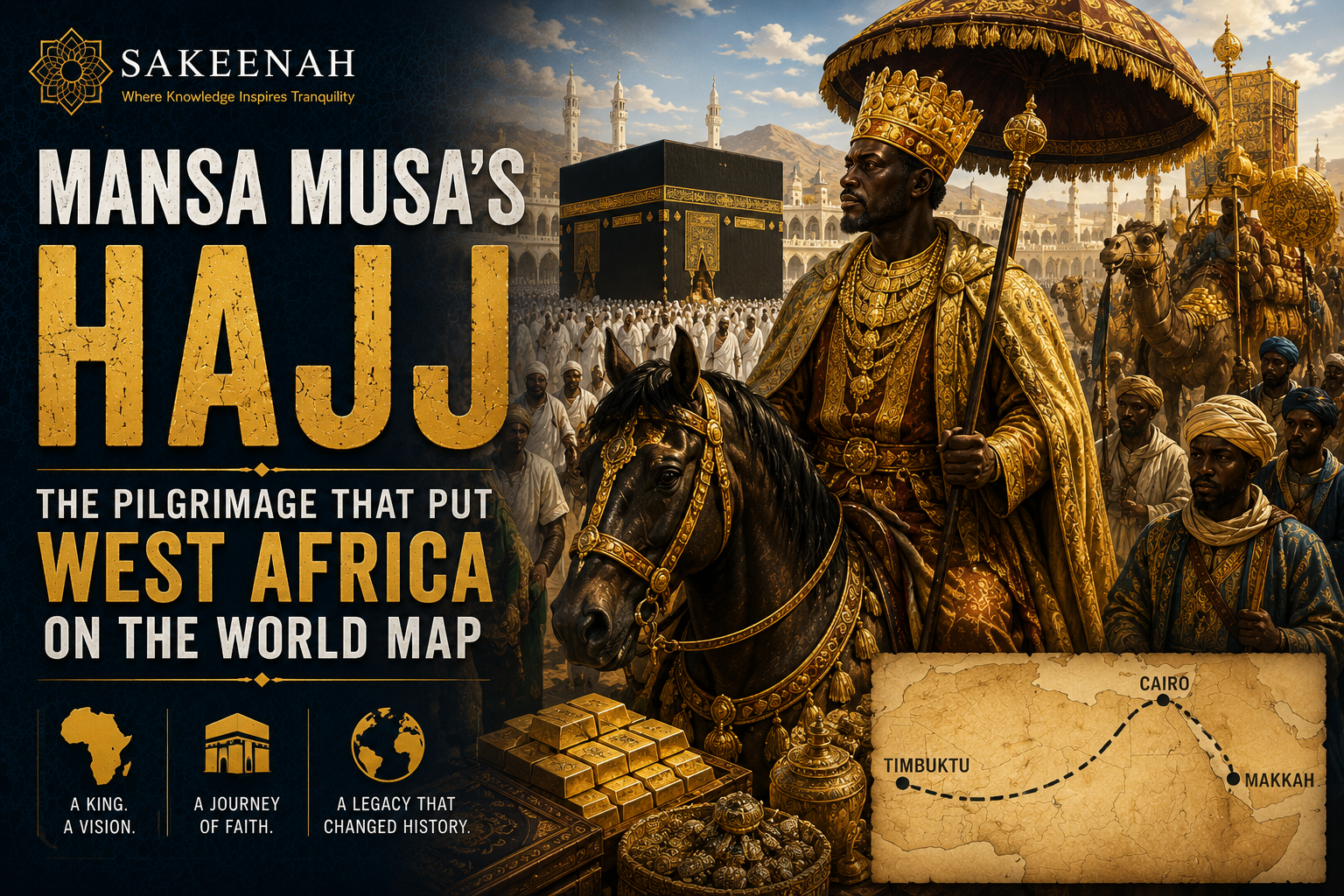
In 1324 CE, Mansa Musa, the tenth mansa, or ruler, of the Mali Empire, departed his capital region along the Niger River bound for Mecca to perform Hajj, accompanied by a caravan whose scale astonished every city it passed through. Contemporary and near-contemporary Arabic sources, most notably the Egyptian chronicler al-Umari, who gathered accounts from Cairo officials just years after Musa's visit, describe a retinue that may have numbered in the tens of thousands, including soldiers, officials, and enslaved attendants, along with camels carrying enormous quantities of gold.
Exact figures vary widely across sources and should be treated with the caution appropriate to medieval numerical claims, but the consistent thread across independent accounts is that Musa's expenditure of gold, particularly during an extended stay in Cairo, was large enough to depress the value of gold in Egyptian markets for years, a detail corroborated by multiple Mamluk-era Egyptian chroniclers writing independently of one another.
The Mali Empire that Mansa Musa ruled had, by the early fourteenth century, become one of the wealthiest and most extensive states in the medieval world, controlling major trans-Saharan trade routes and the gold-producing regions of Bambuk and Bure in West Africa, alongside significant salt trade from Taghaza. Islam had spread into the region gradually over previous centuries through trans-Saharan trade networks connecting West Africa to North Africa and the wider Muslim world, and Mali's rulers, including Musa's predecessors, had been Muslim for generations by the time of his reign, though the empire remained religiously diverse, with Islam concentrated particularly among the ruling and merchant classes.
Musa's own accession followed the disappearance, during an earlier oceanic expedition, of his predecessor Mansa Abu Bakr II, whose fate remains a subject of historical debate.
The core events of the 1324-1325 pilgrimage unfolded across a route running north through the Sahara to cities such as Walata and Tuat before reaching Cairo, where Musa's extended stay became the best-documented portion of his journey due to the detailed Egyptian sources it generated. In Cairo, Musa met with the Mamluk sultan al-Nasir Muhammad, and accounts describe careful diplomatic protocol around Musa's reluctance to prostrate before the sultan, a gesture he considered inappropriate outside worship of Allah, eventually resolved through a face-saving compromise.
From Cairo, Musa continued to Mecca and Medina to complete the rites of Hajj before beginning the long return journey, during which, according to several accounts, he commissioned the construction or expansion of mosques in cities along the route, including in Gao and in his own capital region, and reportedly brought back scholars and architects, most famously the Andalusian architect and poet Abu Ishaq al-Sahili, credited in some traditional accounts with introducing new architectural styles to Mali, including elements associated with the famous Djinguereber Mosque in Timbuktu.
The Islamic significance of Mansa Musa's Hajj lies in what it demonstrated to the wider Muslim world about the scale and sophistication of West African Islamic civilization, a region that many contemporaries in Cairo, Damascus, and beyond had known little about before his arrival. His pilgrimage placed Mali firmly within the broader ummah's networks of scholarship, trade, and pilgrimage, and in the following decades Timbuktu developed into a major center of Islamic learning, home to institutions such as the Sankore Madrasah, which by the fifteenth and sixteenth centuries housed extensive manuscript libraries covering law, astronomy, and theology, some of which survive today and are still being cataloged by scholars and preservation projects in Mali.
The impact on world history extended well beyond religious and regional significance. Musa's journey is often credited with helping to fix West Africa, and specifically Mali, onto European cartographic knowledge; the famous Catalan Atlas of 1375 CE, produced in Majorca, depicts a richly dressed African ruler holding a gold nugget, widely identified by historians as a depiction of Mansa Musa, reflecting how quickly and durably his reputation for wealth spread into European awareness of the wider world, well over a century before Portuguese ships began exploring the West African coast directly.
What mainstream history curricula frequently miss, or address only briefly, is the depth of the West African Islamic scholarly tradition that Musa's pilgrimage helped connect to the wider Muslim world, often reducing the story to a single anecdote about gold and wealth while omitting the sustained intellectual life of Timbuktu and the broader Mali Empire, or the fact that Mali's Islamic institutions continued to develop and produce scholarship for centuries after Musa's reign, well into the era of the Songhai Empire that succeeded it.
For Muslims today, Mansa Musa's Hajj is a reminder of the genuine breadth of the historical ummah, extending across sub-Saharan Africa, the Middle East, Central and South Asia, and beyond, in a network of trade, scholarship, and pilgrimage that connected communities often treated in modern accounts as separate or peripheral. His journey underscores that the story of Islamic civilization in the medieval period cannot be told solely through the lens of Baghdad, Cairo, and Cordoba, but must also include Timbuktu, Gao, and the empires of the West African Sahel, whose contributions to Islamic scholarship and trade were substantial, sustained, and, in Musa's case, visible enough to reshape how the wider medieval world understood the geography of wealth and faith.