

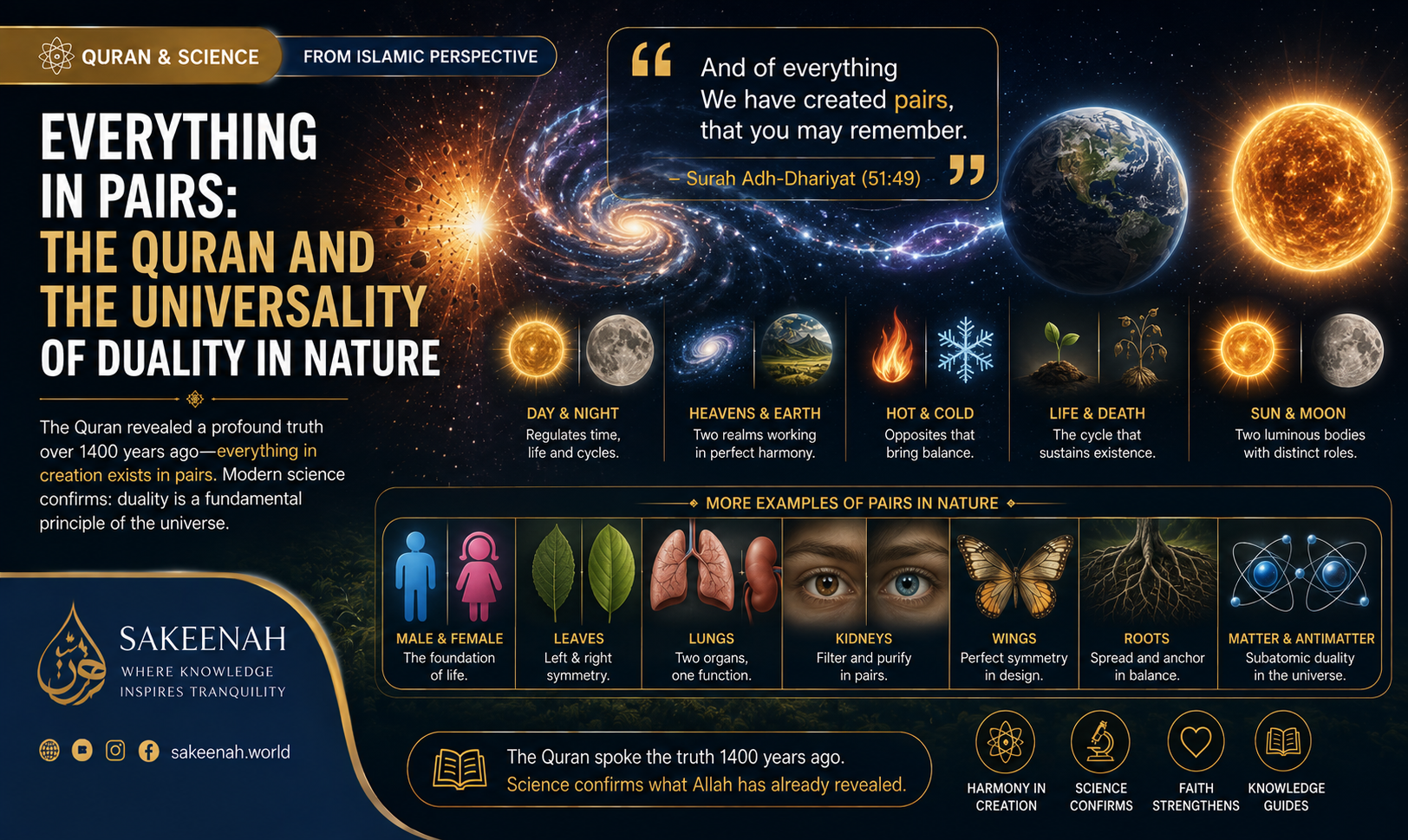
وَمِن كُلِّ شَيۡءٍ خَلَقۡنَا زَوۡجَيۡنِ لَعَلَّكُمۡ تَذَكَّرُونَ
And of all things We created two mates; perhaps you will remember
The verse reads in Arabic: وَمِن كُلِّ شَيْءٍ خَلَقْنَا زَوْجَيْنِ لَعَلَّكُمْ تَذَكَّرُونَ. In transliteration: Wamin kulli shayin khalaqna zawjayni laAAallakum tathakkaroona. The translation: "And of everything We have created pairs, that you may remember." The Arabic word zawjayni is the dual form of zawj, meaning a pair or a mate. It carries the sense of complementary opposites that together constitute a complete unit — not merely two identical things but two things that form a meaningful duality.
The verse's scope is absolute: min kulli shayin, from every thing. This is not restricted to animals or humans but extends to every category of created existence. The purpose clause — la'allakum tatadhakkarun (that you may remember or reflect) — indicates that the principle of pairs is intended as a sign leading to contemplation of the One who is without a pair or partner: Allah alone is unique and without a zawj.
Ibn Kathir, in Tafsir Ibn Kathir, comments on this verse by noting that the pairs in creation are a demonstration of divine wisdom and power. He mentions the obvious pairs — male and female, heaven and earth, day and night, light and darkness, sweetness and bitterness — and extends the principle to the natural world broadly. He emphasises the theological dimension: everything in creation exists in pairs, but Allah alone is al-Wahid al-Ahad — the One, the Unique, without partner or pair.
Al-Qurtubi, in Al-Jami li-Ahkam al-Quran, similarly explores the wide application of the verse, noting that the pairs extend to qualities, states, and categories as well as to physical things. He cites the pairs of belief and disbelief, good and evil, and health and sickness. Both classical scholars acknowledged that the verse's scope was vast, though they interpreted it primarily through theological and moral categories. The scientific dimension of universal pairing was not available to them, but their exegetical method preserved the verse's breadth of application for later reflection.
Modern biology has established that sexual reproduction — based on the pairing of male and female — is nearly universal among complex organisms. But the principle of pairing extends far beyond reproductive biology. In 1928, British physicist Paul Dirac predicted on theoretical grounds the existence of antimatter — a partner to ordinary matter in which every particle has a corresponding antiparticle with opposite charge. This was confirmed experimentally with the discovery of the positron (the antiparticle of the electron) by Carl Anderson in 1932, earning him the Nobel Prize in Physics in 1936.
In botany, the discovery of sexual reproduction in plants — the existence of male and female reproductive structures even in flowering plants — was formalised by Rudolf Jakob Camerarius in 1694. In physics, the forces of the universe operate in complementary pairs: matter and antimatter, positive and negative charge, north and south magnetic poles. In subatomic physics, particles and antiparticles, bosons and fermions, quarks pairing in hadrons. Even the DNA double helix — discovered by Watson, Crick, Franklin, and Wilkins and published in 1953 — is a pairing structure: two complementary strands wound around each other, each base paired with its complementary counterpart.
The Quranic verse's claim that everything is created in pairs encompasses a principle that biology, physics, and chemistry have all confirmed from their respective domains. The universality of complementary duality — from the pairing of chromosomes in genetics to the pairing of forces in physics — suggests that the principle is not a biological accident but a structural feature of creation at multiple levels of organisation. The verse is particularly prescient in its use of min kulli shayin — from every thing — which extends beyond the obvious pairs of biological sex to encompass the structural duality underlying physical reality.
Paul Dirac, reflecting on the mathematical symmetry that led him to predict antimatter, spoke of the beauty of the equations that demanded a partner for every particle of matter. The Quran's insistence on universal pairing aligns with this deep structural feature of the physical world.
Honest scholarship requires acknowledging that the verse's primary context is theological and reflective, not scientific. The Quran is using the observation of pairs as a path to remembering Allah's uniqueness — it is an argument from creation to Creator, not a scientific taxonomy. The word zawjayni does not necessarily mean male/female in every context; it can mean complementary opposites, pairs, or types, and classical scholars interpreted it broadly. The scientific correspondences — antimatter, sexual reproduction, complementary DNA strands — are genuine but go beyond what the verse explicitly states.
It would be an over-claim to say the Quran predicted the discovery of antimatter. The honest assessment is that the verse articulates a principle of universal duality that turns out to be structurally true at multiple levels of scientific understanding — a convergence that is intellectually significant even without claiming predictive precision.
For the Muslim believer, this verse closes with a purpose statement that elevates it above a mere scientific claim: laAllakum tatadhakkarun — so that you may remember. The Arabic word tatadhakkarun comes from dhikr, meaning remembrance or reflection, particularly the remembrance of Allah. The pairs in creation are not ends in themselves; they are pointers. Every pair implies the existence of something that is not a pair — the Single, the Unique, the One who created the pairs from His own singularity.
When modern science reveals the pairing of particles and antiparticles, the pairing of DNA strands, the pairing of reproductive cells, the believer is invited to see in each of these an echo of the Quranic principle and a sign pointing toward the tawhid — the divine unity — that underlies all of creation. The universe's structure mirrors the Quran's theology: plurality and duality at every level, pointing back to the One.
Science changes as knowledge grows; the Qur'an is guidance, not a science textbook. These reflections are offered to encourage thinking about the signs in creation.