

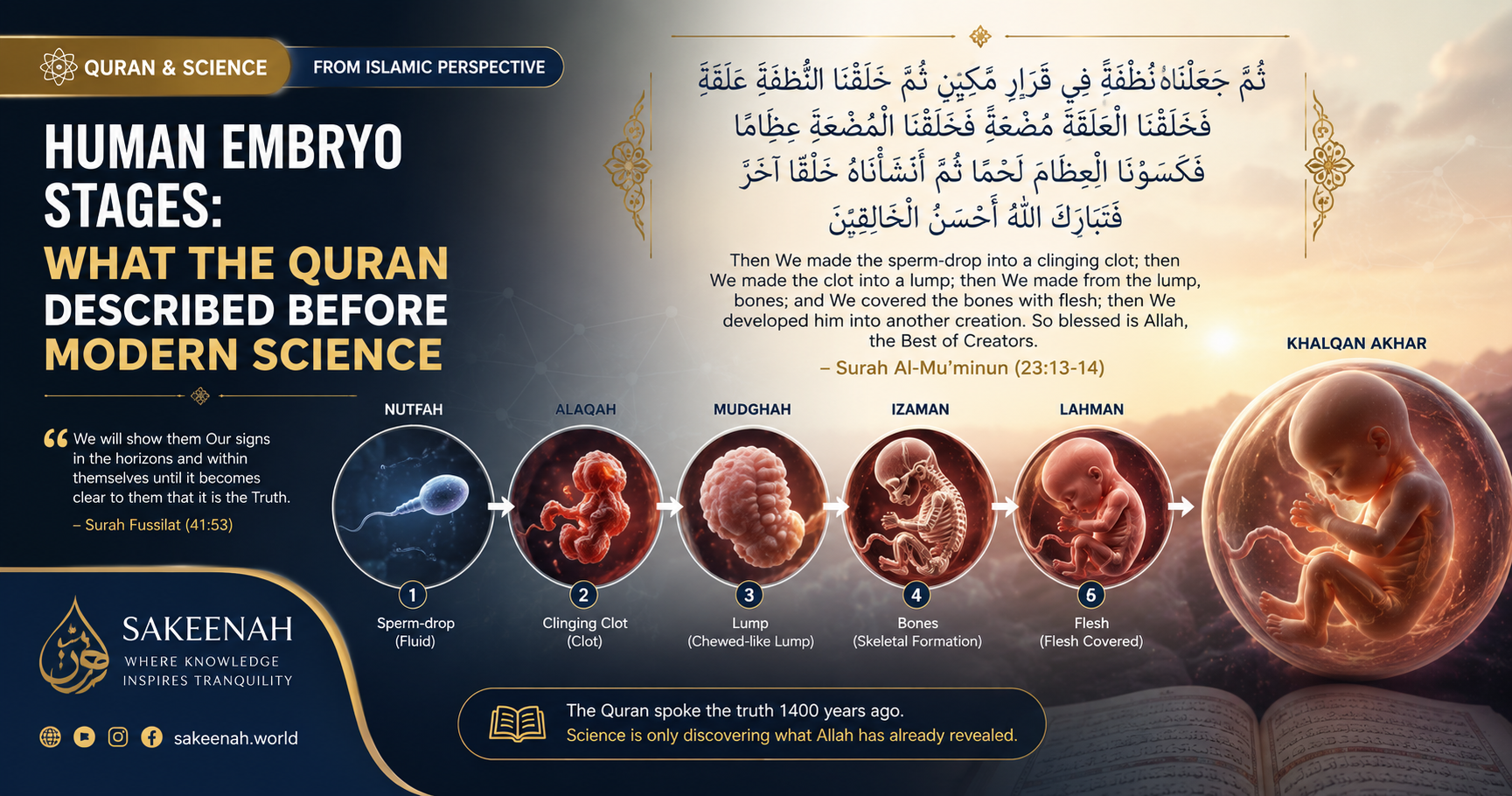
ثُمَّ جَعَلۡنَٰهُ نُطۡفَةٗ فِي قَرَارٖ مَّكِينٖ ثُمَّ خَلَقۡنَا ٱلنُّطۡفَةَ عَلَقَةٗ فَخَلَقۡنَا ٱلۡعَلَقَةَ مُضۡغَةٗ فَخَلَقۡنَا ٱلۡمُضۡغَةَ عِظَٰمٗا فَكَسَوۡنَا ٱلۡعِظَٰمَ لَحۡمٗا ثُمَّ أَنشَأۡنَٰهُ خَلۡقًا ءَاخَرَۚ فَتَبَارَكَ ٱللَّهُ أَحۡسَنُ ٱلۡخَٰلِقِينَ
Then We placed him as a sperm-drop in a firm lodging Then We made the sperm-drop into a clinging clot, and We made the clot into a lump [of flesh], and We made [from] the lump, bones, and We covered the bones with flesh; then We developed him into another creation. So blessed is Allah, the best of creators
The verses read in Arabic: ثُمَّ جَعَلْنَاهُ نُطْفَةً فِي قَرَارٍ مَّكِينٍ ثُمَّ خَلَقْنَا النُّطْفَةَ عَلَقَةً فَخَلَقْنَا الْعَلَقَةَ مُضْغَةً فَخَلَقْنَا الْمُضْغَةَ عِظَامًا فَكَسَوْنَا الْعِظَامَ لَحْمًا ثُمَّ أَنشَأْنَاهُ خَلْقًا آخَرَ فَتَبَارَكَ اللَّهُ أَحْسَنُ الْخَالِقِينَ. In transliteration: Thumma jaAAalnahu nutfatan fee qararin makeenin, thumma khalaqna alnnutfata AAalaqatan fakhalaqna alAAalaqata mudghatan fakhalaqna almudghata AAithaman fakasawna alAAithama lahman thumma ansha/nahu khalqan akhara fatabaraka Allahu ahsanu alkhaliqeena. The translation: "Then We placed him as a sperm-drop in a firm lodging. Then We created the sperm-drop into a clinging clot, and We created the clot into a lump of flesh, and We created the lump into bones, and We covered the bones with flesh; then We developed him into another creation. So blessed is Allah, the best of creators."
The passage identifies the following stages: nutfah (sperm-drop or mixed fluid), alaqah (clinging clot or leech-like structure), mudghah (chewed lump of flesh), then bones, then the covering of bones with flesh, and finally a wholly new creation — a fully formed human being.
Ibn Kathir, in Tafsir Ibn Kathir, provides a detailed commentary on these verses, noting that nutfah refers to the drop of fluid that carries the seed of life, placed by Allah in a qararim makeen — a secure and stable resting place, which scholars understood as the uterus. He explains alaqah as something that clings, drawing on both its literal Arabic meaning of "that which clings" and its resemblance to a blood clot.
The mudghah he describes as a lump that resembles a chewed piece of meat — an interpretation corroborated, as we shall see, by actual embryological observation. Al-Qurtubi, in Al-Jami li-Ahkam al-Quran, also addresses these verses extensively, connecting them to the hadith of Ibn Masud (may Allah be pleased with him) reported in Sahih Al-Bukhari and Sahih Muslim, in which the Prophet Muhammad ﷺ described the same developmental stages and assigned approximate timeframes of forty days to each initial phase. Both classical scholars treated the sequence as a precise description of the actual physical process of human creation, not a metaphorical account.
Modern embryology, as a formal discipline, began to emerge in the seventeenth century with William Harvey's foundational work on generation, but the actual microscopic stages of human development were not mapped with precision until the nineteenth and twentieth centuries. Karl Ernst von Baer established the science of comparative embryology in the 1820s. The Carnegie stages, the internationally accepted system for classifying human embryonic development into 23 discrete stages, were established progressively through the work of researchers at the Carnegie Institution of Washington from the early twentieth century onwards.
What these studies revealed is that the human embryo does indeed pass through a stage where it resembles a clinging, blood-rich structure attached to the uterine wall — corresponding strikingly to the alaqah description. The mudghah stage, around days 26 to 28 of development, produces an embryo with visible somites along its back that give it the appearance of a chewed or indented lump of flesh. Keith Moore, a Canadian professor of anatomy and embryology at the University of Toronto, famously noted in the 1980s that the Quranic descriptions of the mudghah corresponded precisely with what embryologists observe at that developmental stage.
The correspondence between the Quranic sequence and modern embryological staging is, by any fair analysis, remarkable. The seven-stage sequence — fluid, clot, chewed lump, bones, flesh over bones, and then a new creation — maps onto known developmental milestones with a degree of accuracy that would have been impossible to derive from casual observation. The interior of the womb is not visible to the naked eye; a seventh-century Arab had no means of examining embryos under a microscope.
The particular detail that bones form before flesh is especially noteworthy: histological studies confirm that the skeletal framework does indeed differentiate and solidify before the muscular and connective tissue fully forms around it. The Quran's choice of language — particularly alaqah (which means both clot and leech) and mudghah (indented lump) — describes visual and structural features of the embryo that were not known to human medicine at the time of revelation.
There are legitimate scholarly debates that must be acknowledged. Some critics of the Quran-embryology thesis argue that Greek physician Galen described certain aspects of fetal development, and that Arabic physicians of late antiquity may have had access to such traditions. Others point out that alaqah could be interpreted spiritually rather than anatomically. The honest assessment is that the Quranic description is more sequential and more accurate than what Greek medicine had formally articulated, and that the precise Arabic terminology — particularly alaqah's dual meaning of both a clinging entity and a leech-like form — corresponds to observable embryological structures in a way that exceeds mere coincidence.
However, scholars such as Dr. Yasir Qadhi caution against over-claiming and remind us that the Quran is not a textbook of embryology; it uses these stages as signs of divine power, not as a scientific manual. The connection is strong, but it should be presented as a convergence of revelation and discovery, not as a simple prediction fulfilled.
For the believing Muslim, these verses carry a message that transcends the scientific debate entirely. The Quran concludes this passage with the exclamation: "So blessed is Allah, the best of creators" — an expression of wonder at the complexity and beauty of the process by which a human being emerges from a single drop of fluid. When modern science reveals that this process involves intricate genetic programming, precisely timed hormonal signals, and a sequence of structural transformations so complex that it still astonishes molecular biologists, the believer is invited to join in that exclamation.
The precision of the Quran's language and the precision of the embryological process are both reflections of the same divine wisdom. That an illiterate man in seventh-century Arabia could convey a description that aligns with the findings of modern microscopy is not a coincidence the believing mind can comfortably dismiss — it is a sign, an ayah, demanding sincere reflection.
Sayansi hubadilika kadiri elimu inavyokua; Qur'ani ni mwongozo, si kitabu cha sayansi. Tafakuri hizi zinatolewa ili kuhamasisha kufikiri kuhusu ishara zilizo katika uumbaji.