

۞وَهُوَ ٱلَّذِي مَرَجَ ٱلۡبَحۡرَيۡنِ هَٰذَا عَذۡبٞ فُرَاتٞ وَهَٰذَا مِلۡحٌ أُجَاجٞ وَجَعَلَ بَيۡنَهُمَا بَرۡزَخٗا وَحِجۡرٗا مَّحۡجُورٗا
And it is He who has released [simultaneously] the two seas, one fresh and sweet and one salty and bitter, and He placed between them a barrier and prohibiting partition
The verse reads in Arabic: وَهُوَ الَّذِي مَرَجَ الْبَحْرَيْنِ هَٰذَا عَذْبٌ فُرَاتٌ وَهَٰذَا مِلْحٌ أُجَاجٌ وَجَعَلَ بَيْنَهُمَا بَرْزَخًا وَحِجْرًا مَّحْجُورًا. Its transliteration is: Wa huwa allathee maraja albahrayni hatha AAathbun furatun wahatha milhun ojajun wajaAAala baynahuma barzakhan wahijran mahjooran. The translation: "And it is He who has released the two seas, meeting — one fresh and sweet and one salty and bitter, and He placed between them a barrier and prohibiting partition."
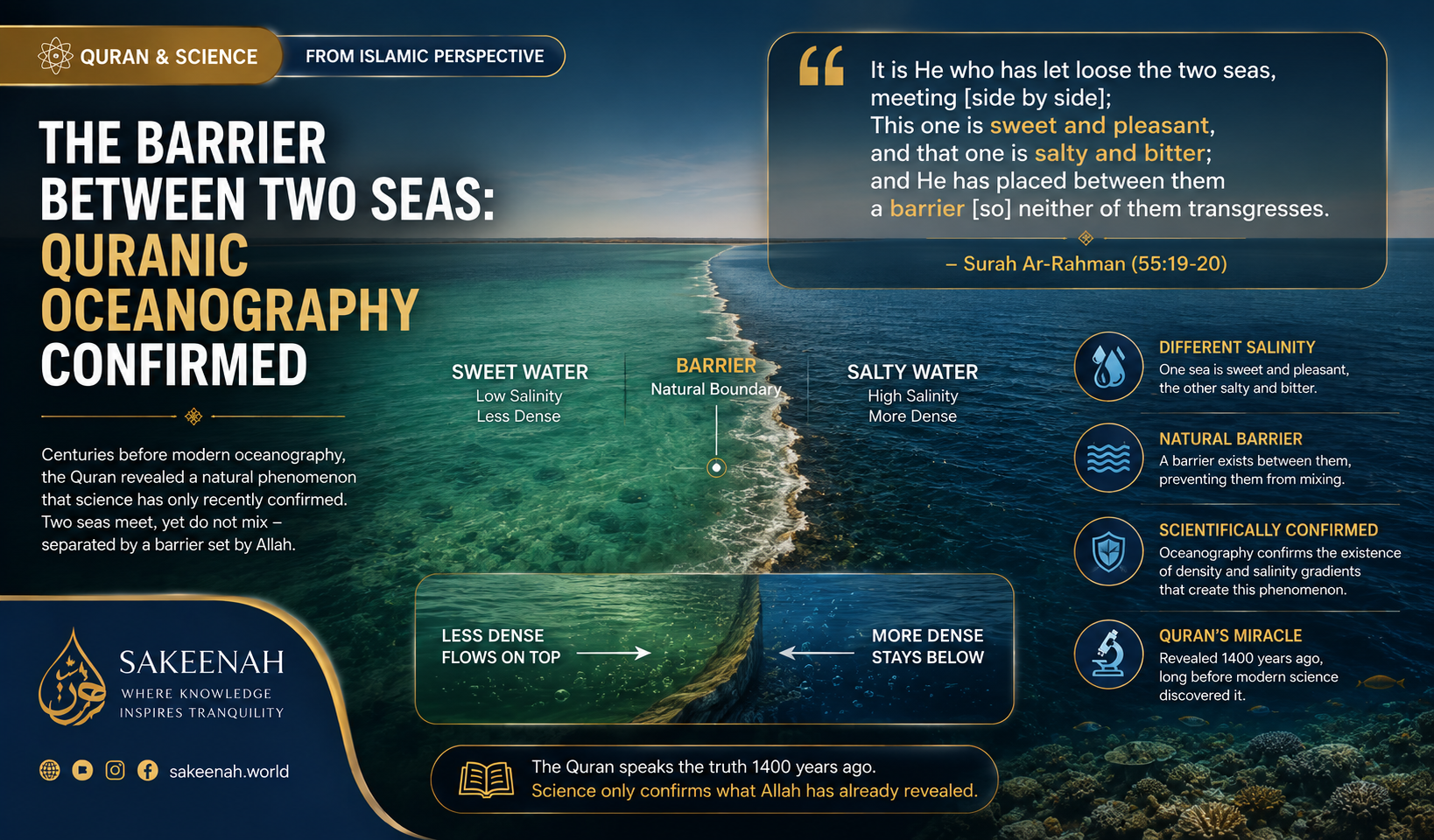
Three Arabic terms are central here. Barzakh means a partition or isthmus — something that stands between two things and prevents them from fully merging. Hijran mahjooran means a forbidden and prohibiting separation — something that acts as an active barrier. The two seas are described as having entirely different qualities: one is adzb furat (fresh and palatable) while the other is milh ujaj (salty and bitter). The verse does not merely describe two bodies of water side by side; it asserts that despite their meeting, they maintain their distinct characters because of a barrier placed between them by divine decree.
Ibn Kathir, in Tafsir Ibn Kathir, comments on this verse by noting that this is among the signs of Allah in His creation — that He allows the two seas to come together yet prevents them from mixing in a way that would destroy the qualities of each. He references the Quranic companion verse in Surah Al-Rahman (55:19-20), which also describes the two seas meeting without merging: "He released the two seas, meeting each other. Between them is a barrier which they do not transgress."
Ibn Kathir acknowledges that the barrier is not a physical wall visible to the eye but a divine constraint placed within the nature of the waters themselves. Al-Qurtubi, in Al-Jami li-Ahkam al-Quran, similarly notes that the barzakh is a divine arrangement rather than a tangible structure, and that the prevention of mixing is a matter of Allah's sustaining power over creation. Neither scholar had access to the tools of hydrography, yet their theological reading of the verse anticipated its physical explanation: the barrier is real but invisible.
The scientific explanation for the barrier between bodies of water with different salinity and temperature was formally investigated and described by modern physical oceanography. Jacques-Yves Cousteau, the French marine explorer, famously reported observing the meeting of the Mediterranean Sea and the Atlantic Ocean and noting that the two maintained distinct qualities for long stretches before mixing. More rigorously, the field of halocline and thermocline research — which examines how layers of water with different salinity, density, and temperature resist mixing — developed significantly through the twentieth century.
Oceanographer Dr. William Hay of the University of Colorado studied the phenomenon extensively and noted that different bodies of water, such as the Gulf of Mexico and the Atlantic, possess their own distinct temperature, salinity, density, and marine life compositions, and that they maintain this distinction even where they meet. The barrier is a product of the physical properties of water: differences in density create a pycnocline — a zone of rapid density change — that resists vertical mixing and maintains stratification.
This phenomenon has been documented at the meeting of the Mediterranean and Atlantic, at river mouths meeting the sea, and between deep and surface ocean layers globally.
The Quranic verse and the oceanographic finding converge on a shared insight: meeting does not mean merging. The verse states that the two seas flow together (maraja — a word implying release and movement, not static separation) and yet a barzakh prevents their qualities from dissolving into one another. Modern oceanography confirms that this is precisely what happens: salinity gradients, surface tension differences, and density stratification create natural barriers that cause the fresh and saltwater to maintain separate identities even at their interface.
At the meeting of rivers and seas, a halocline forms — a layer where salinity changes sharply — creating a physical barrier that slows or prevents the full mixing of the two bodies. The connection between the verse and the science is therefore not merely metaphorical; it describes a real, observable, and now measurably documented physical phenomenon.
Honesty in scholarship requires noting that ancient peoples did observe fresh and saltwater meeting at river estuaries and were aware that the sea is salty and rivers are fresh. One could argue that the verse merely reflects common experience. However, the Quran goes further: it ascribes to the phenomenon a barzakh and a hijr mahjooran — an active barrier that preserves the distinction against mixing. This is not common-sense observation but a specific physical claim about the mechanism of separation.
The claim was not scientifically explained until the development of hydrographic science in the nineteenth and twentieth centuries. It is fair to say that the verse's precise language goes beyond what ordinary observation would yield, even if the general phenomenon of distinct seas was known. The strength of the correspondence lies in the mechanism — the barrier — not merely in the observation of different waters.
For the Muslim believer, this verse is part of a broader Quranic pattern of pointing to natural phenomena as signs of divine wisdom and power. The oceans cover over seventy percent of the Earth's surface and are the source of much of the water cycle that sustains life. That Allah has placed within the very physical properties of water a mechanism that maintains the balance of fresh and saltwater ecosystems is a profound sign of the design built into creation.
The barzakh between the seas is not merely a scientific curiosity; it is a metaphor the Quran also uses for the barrier between this life and the next, and between the seen and unseen worlds. In all these domains, the Quran presents divine management as the underlying principle of order. The oceanographic confirmation of the barrier between seas adds a dimension of physical concreteness to what was always a theological truth: Allah has set the boundaries of creation, and they do not transgress their limits.
Sayansi hubadilika kadiri elimu inavyokua; Qur'ani ni mwongozo, si kitabu cha sayansi. Tafakuri hizi zinatolewa ili kuhamasisha kufikiri kuhusu ishara zilizo katika uumbaji.