

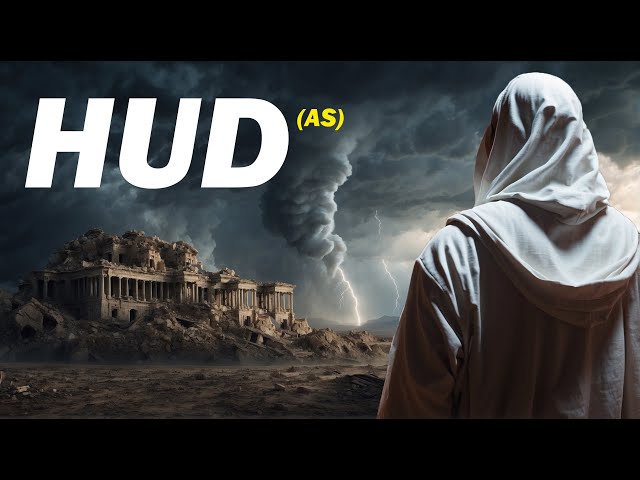
Hud ibn 'Abir (Hud, peace be upon him)
Prophet Hud (peace be upon him) was a messenger sent to the mighty 'Ad people of ancient Arabia, a civilization renowned for their towering architecture and immense physical strength. He stands as one of the few Prophets explicitly identified as Arab in origin, making his story a direct address to the people of the Arabian Peninsula across all generations.
Pre-Abrahamic Ancient Arabia · Circa 2400–2100 BCE (traditional Islamic historical reckoning)
In the vast, wind-carved valleys of Al-Ahqaf, somewhere in the southern reaches of the Arabian Peninsula, there lived a civilization that had made the earth tremble beneath their ambitions. The people of 'Ad were not a humble folk. They raised towering pillars upon the high places of the land — monuments that pierced the sky as declarations of their own permanence. They were tall in stature, formidable in strength, and drunk on the intoxication of worldly power.
Among them walked a man named Hud — one of their own, born of their lineage, known for his soundness of character and clarity of speech. Allah had sent him to them, as recorded in Surah Al-A'raf and Surah Hud, with the same call every Prophet carried: worship Allah alone, and abandon the false gods your hands have fashioned. Hud, peace be upon him, was not a stranger arriving from distant lands.
He was their kinsman, and this made his message both more intimate and more threatening to the 'Ad. He knew their language, their pride, and the precise shape of their arrogance. His opening was not condemnation but reminder. As Allah records in Surah Al-Ahqaf (46:21), he called them to remember how Allah had made them successors after the people of Nuh and had increased them greatly in power and stature.
He was asking them to read their own history honestly — they had been raised up after a previous civilization had been erased for the very same pride they were now rehearsing. But the chiefs of 'Ad were not moved. They said to Hud, as recorded in Surah Al-A'raf (7:66), that they considered him a fool and a liar, and they accused him of having lost his mind for daring to call them away from the gods of their ancestors.
Year after year, Hud, peace be upon him, persisted. He reminded them of Allah's favors — their livestock, their children, their gardens, and their springs of water. He warned them that ingratitude had consequences. He promised them that if they turned back to their Lord, He would increase them in provision and strength. But the 'Ad had a particular kind of deafness that comes not from the ears but from the heart, the deafness of those who have concluded that their own power is sufficient explanation for their existence.
Their leaders actively worked to turn the common people against Hud, mocking him publicly and spreading the claim that he was simply a madman cursed by one of the tribal deities. Al-Tabari, drawing on early Islamic historical accounts, records that only a small group of the 'Ad believed — and they were marginalized, pressured, and ridiculed by the ruling class who had the most to lose if tawhid took hold.
Then came the drought. The rains ceased. The land that had been lush enough to sustain one of the ancient world's great civilizations began to crack and harden. The 'Ad, in their distress, sent a delegation to Makkah — to the sacred precinct near the Ka'bah, which was already recognized as a place of prayer — to beseech the gods for rain. A man named Qeyl led the delegation, and various others joined him.
According to accounts preserved by Ibn Kathir in Al-Bidayah wal-Nihayah, they were offered a choice through a vision: a white cloud, a red cloud, or a black cloud. Proud even in supplication, the delegation chose the black cloud, thinking it carried the heaviest rain. They rushed back to give the 'Ad the news. When the people of 'Ad saw the cloud approaching on the horizon, broad and dark and moving toward their valleys, they rejoiced. 'This is a cloud bringing us rain,' they said to one another, stepping out from their stone dwellings to receive what they believed was their answered prayer.
But it was not rain. Allah, the Exalted, records in Surah Al-Ahqaf (46:24–25) what Hud said as they celebrated: 'Rather, it is that which you were impatient for — a wind wherein is a painful punishment, destroying everything by the command of its Lord.' The wind struck. It was not an ordinary wind. Classical commentators, including Ibn Kathir, describe it as a ferocious, ice-cold gale that Allah unleashed upon the 'Ad for seven nights and eight days without ceasing — a detail confirmed in Surah Al-Haqqah (69:6–7).
The people tried to take shelter. They fled into their great stone structures, those same towering pillars they had built as monuments to their own power. But the wind tore through everything. It lifted men from the ground and flung them down like hollow palm trunks. It stripped the flesh from their bones. The Quran in Surah Al-Dhariyat (51:41–42) describes it as leaving nothing it reached except that it made it like decayed ruins.
In eight days, one of the most powerful civilizations of the ancient world was erased. Hud, peace be upon him, and the small company of believers who had stood with him were spared. Allah protected them — as He has always protected those who hold fast to the truth — while the wind raged around them. This detail is recorded in Surah Hud (11:58): 'And when Our command came, We saved Hud and those who believed with him, by mercy from Us; and We saved them from a harsh punishment.' After the destruction, Hud and his small community departed.
Classical historians place them as eventually settling in Hadramawt in Yemen, where Hud, peace be upon him, is said to have lived out his remaining years and where his tomb — a site of long-standing reverence — is traditionally located to this day. The legacy of Hud, peace be upon him, is woven permanently into the fabric of the Quran. An entire surah bears his name. His story is one of the most frequently recurring accounts in the Book of Allah, told and retold from different angles across multiple surahs — Al-A'raf, Hud, Al-Mu'minun, Al-Shu'ara, Al-Ahqaf, Al-Haqqah, Al-Dhariyat — because its lesson is inexhaustible.
Every generation of humanity produces its own version of the 'Ad: civilizations that mistake strength for permanence, that confuse material achievement with divine favor, that silence the voices of warning in their midst. The story of 'Ad is not a relic of ancient Arabia. It is a mirror. What endures from the life of Hud, peace be upon him, is the portrait of a Prophet who never stopped loving his people even as they rejected him — who called them with patience and sincerity until the very moment Allah's decree fell.
His was not a cold, detached proclamation of doom. It was the aching persistence of a man who genuinely wanted his people to be saved and who understood, more clearly than they did, what was at stake. For every believer who has ever felt alone in standing for truth within their own community, who has been mocked by those they love, or who has watched their sincere counsel be dismissed as foolishness, the story of Hud is a sustaining light.
He fulfilled his covenant. He was honored by Allah. And the wind that silenced every voice of arrogance could not touch the one who had bent his will entirely to his Lord.
Mafunzo kutoka kisa hiki
- Belonging to a community does not obligate silence about its wrongs. Prophet Hud was from the 'Ad people themselves, yet he stood alone among them with the truth. Proximity to wrongdoing is not permission for it — it is, in fact, a greater call to speak with clarity and compassion.
- Worldly power, no matter how impressive, offers no protection against the decree of Allah. The 'Ad were the most formidable people of their age, yet a wind reduced them to hollow ruins in eight days. True security belongs only to those who anchor themselves in submission to Allah.
- The task of the believer is to deliver the message faithfully and then trust Allah with the outcome. Hud fulfilled his covenant completely, was saved with those who believed, and was honored by Allah for eternity — even though the overwhelming majority rejected him. Divine success is never measured by popular approval.
Kuishi nayo leo
In an age where belonging often demands silence — where speaking truth within one's own community, family, or nation is framed as disloyalty — the story of Hud (peace be upon him) is a bracing reminder that authentic love for one's people sometimes looks like standing apart from them. A Muslim today who sees wrong normalized in their own community, workplace, or family circle may feel the pull of silence far more acutely than the pull of a stranger's criticism.
The lesson of Hud is that the one who truly loves his people warns them, even when the warning is unwelcome. That warning, delivered with sincerity and without arrogance, is itself the deepest form of mercy. The destruction of 'Ad by an unstoppable wind also speaks directly to a temptation modern Muslims must examine honestly: the urge to find security in material power. The 'Ad asked, 'Who is stronger than us?' — and that question was their spiritual epitaph, because it had no room in it for Allah.
When a believer today is tempted to measure blessing purely by financial strength, national prestige, technological achievement, or social status, the story of Al-Ahqaf offers a quiet but devastating corrective. Build, yes — but build with gratitude. Excel, yes — but let excellence turn you toward your Lord rather than away from Him. The civilization that raised the greatest pillars of its age was leveled in eight days. What remains standing, across millennia, is the word of the Prophet they dismissed as a fool.