

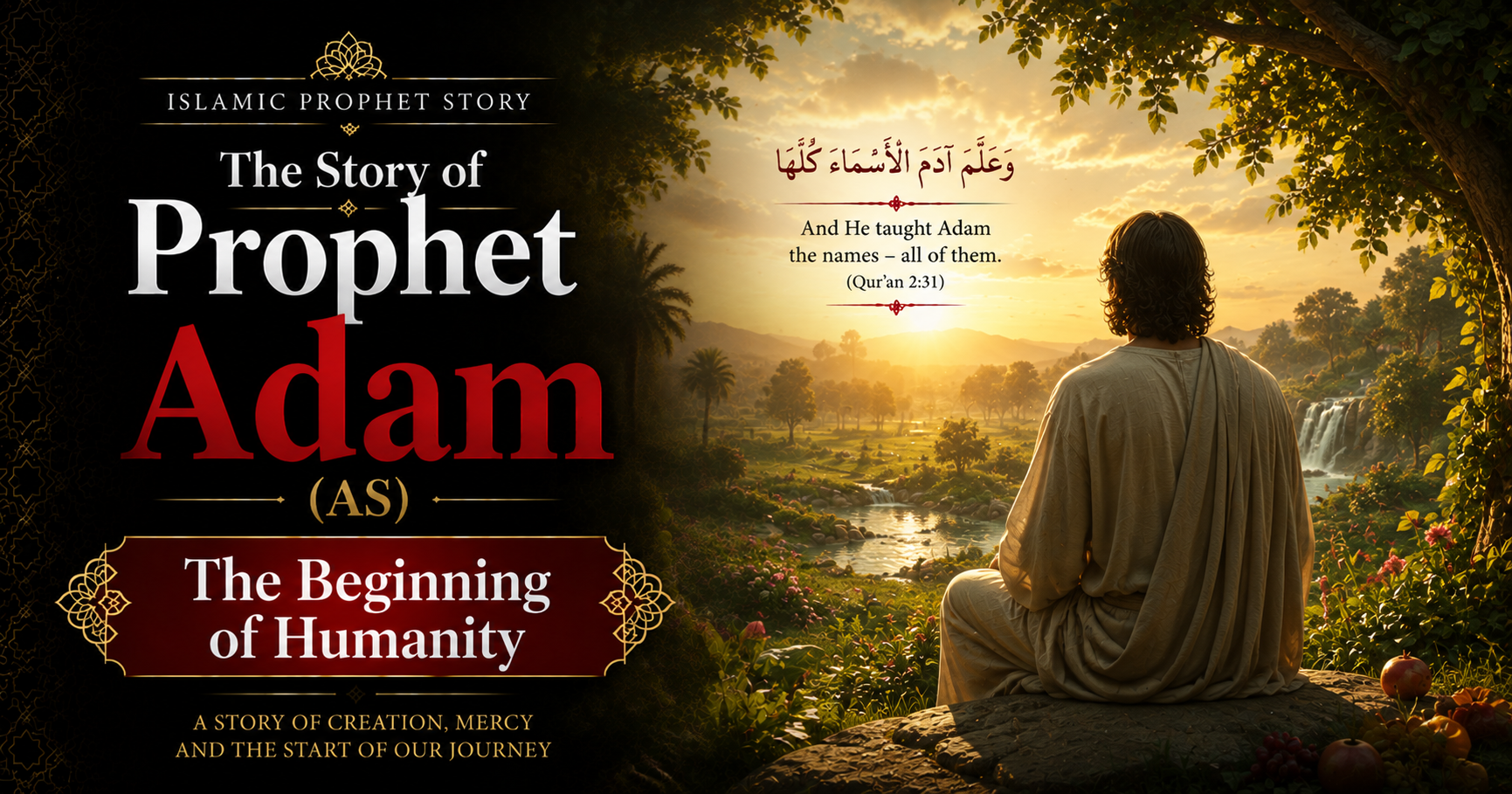
Adam (peace be upon him), the first human being and first Prophet
Prophet Adam (peace be upon him) was the first human being created by Allah and the first Prophet sent to humanity — the father of the entire human race and the original recipient of divine knowledge, language, and the covenant of khilafah, the stewardship of the earth. His story in the Quran establishes the foundational theological framework of Islamic anthropology: who human beings are, why they were created, what Iblis is and why he is dangerous, and how tawbah — sincere repentance — is the defining human response to the inevitability of error.
The Beginning of Human Creation, Before Recorded Time · The Beginning of Human Existence (before recorded historical time)
In the realm before human time, when the earth had been created and the heavens arranged and the angels had been worshipping for ages without number, Allah announced to the angels something they had not been prepared for. The Quran records in Surah Al-Baqarah (2:30) the announcement and the angels' response: 'And when your Lord said to the angels, Indeed, I will make upon the earth a successive authority — they said, Will You place upon it one who causes corruption therein and sheds blood, while we declare Your praise and sanctify You?' The angels' question was not a protest but a genuine inquiry — how could a being with the capacity for bloodshed and corruption be a better steward of the earth than the angels who had never deviated from the worship of Allah?
Allah's answer was not an argument but a demonstration: 'Indeed, I know that which you do not know.' He then created Adam, peace be upon him, from the earth itself — from clay, as the Quran specifies across multiple passages, and from its distinctive characteristics: the Quran describes it in various verses as dry clay, as altered black mud, as clay like pottery. The hadith tradition adds further detail: in Sahih Muslim, the Prophet Muhammad, peace be upon him, narrated that Allah created Adam from a handful of earth gathered from all across the world, which is why the children of Adam come in all colors and temperaments — red and white and black, soft and hard and in between — reflecting the diversity of the soil from which their father was formed.
The creation of Adam, peace be upon him, was unlike anything Allah had done before in the realm of physical existence. The Quran records in Surah Al-Hijr (15:29) the divine announcement: 'So when I have proportioned him and breathed into him of My spirit, then fall down to him in prostration.' The breathing of the ruh — the spirit — into the clay form of Adam is the moment at which the human being becomes something distinct from the rest of the created world: not merely a sophisticated animal, not merely a refined clay figure, but a being that carries within itself something of divine trust and divine responsibility that no other earthly creation possesses.
The angels prostrated — all of them — in fulfillment of the divine command. All except one. Iblis refused. The Quran records his refusal in Surah Al-A'raf (7:12) with an arrogance that is both simple and devastating: 'I am better than him. You created me from fire and created him from clay.' It was the first act of kibr — arrogance — in the history of creation, and it was committed before the first human being had taken a single step.
Iblis was expelled. But he was not immediately destroyed. He was given respite — until the Day of Judgment — and he used his first words of respite to declare his purpose: 'Because You have put me in error, I will surely sit in wait for them on Your straight path. Then I will come to them from before them and from behind them and on their right and on their left, and You will not find most of them grateful.' The war that would define all of human history had been declared before Adam had yet spoken a word.
Allah taught Adam, peace be upon him, the names of all things — a detail the Quran records in Surah Al-Baqarah (2:31) as the demonstration that answered the angels' question about the capacity of the human being for khilafah. When Allah asked the angels to inform Him of the names of the things He had created, they said: 'Exalted are You; we have no knowledge except what You have taught us.
Indeed, it is You who is the Knowing, the Wise.' Then Adam was asked to name them, and he named them all. This was the divine argument for the human capacity to serve as Allah's khalifah on earth: not physical strength, not purity from sin, but the capacity for knowledge — the ability to receive, retain, process, and apply understanding of the names and natures of created things. Ibn Kathir notes in his Tafsir that the scholars understand 'the names' to encompass not merely nouns but the entire domain of human knowledge — the sciences, the arts, the crafts, the relationships between things — everything that the human mind is capable of learning and transmitting.
The khalifah of Allah on earth was given this capacity first, before he was placed in the garden, because the capacity for knowledge was the basis of the responsibility.
The garden — Jannah, or an earthly garden of extraordinary provision, as scholars differ on its precise nature — was placed at Adam's disposal, and with him was his wife Hawwa, created from him as the Quran records in Surah Al-Nisa (4:1), to be his companion and the co-bearer of the human mission. Everything in the garden was permitted to them except one tree — referred to in the Quran simply as 'this tree,' without specification of its nature — which they were told not to approach, lest they be among the wrongdoers.
The command was clear, the prohibition single and specific, the provision around them overwhelming. And then Iblis, who had been given his access, whispered. The Quran records in Surah Ta-Ha (20:120) the nature of the whisper: 'O Adam, shall I direct you to the tree of eternity and possession that will not deteriorate?' He reframed the prohibition as a deprivation — as if the one tree that was forbidden was the key to something Adam and Hawwa lacked.
He swore by Allah that he was a sincere adviser. And they ate. The Quran records in Surah Ta-Ha (20:121) that they both ate, that their nakedness became apparent to them, and that they began to cover themselves with the leaves of the garden. Then came the call — rendered in the classical commentaries as a call of divine attention, not anger alone — 'Did I not forbid you from that tree and tell you that Shaytan is to you a clear enemy?' And Adam and Hawwa, peace be upon them, did what Iblis had never done when he erred: they turned immediately to their Lord and said, as the Quran records in Surah Al-A'raf (7:23), 'Our Lord, we have wronged ourselves, and if You do not forgive us and have mercy upon us, we will surely be among the losers.'
This prayer — Rabbana zalamna anfusana wa in lam taghfir lana wa tarhamna lana kunan minal khasirin — is among the most important words in the entire Quran, not because of the sin that preceded it but because of the transformation it represents. Adam and Hawwa, peace be upon them, did not make excuses. They did not blame the circumstances, minimize the violation, or redirect responsibility. They said: we wronged ourselves.
The contrast with Iblis's response to his own error is the theological heart of the story: Iblis, when confronted with his refusal to prostrate, blamed Allah — 'Because You have put me in error.' Adam, when confronted with his eating from the tree, took responsibility — 'We have wronged ourselves.' This is the difference between the path that leads to eternal loss and the path that leads back to Allah's mercy.
The Quran records in Surah Al-Baqarah (2:37) that Allah 'chose him and turned to him in forgiveness and guided him' — the forgiveness was complete, the repentance was accepted, and the relationship was restored. Adam and Hawwa, peace be upon them, were then sent down to earth — not as a punishment, as classical scholars including Ibn Kathir are careful to clarify, since the sending down had been part of the divine plan announced to the angels before Adam was created, when Allah said 'I will make upon the earth a successive authority' — but as the beginning of the human mission.
Allah sent Adam, peace be upon him, to earth as the first Prophet — the first human being to receive divine guidance and transmit it to his offspring. Ibn Kathir records in Al-Bidayah wal-Nihayah, drawing on authenticated hadith, that Adam received a scripture of pages — suhuf — from Allah, making him not only the first human but the first recipient of revelation. He and Hawwa descended to earth — classical scholars differ on their landing points, with some placing Adam in India and Hawwa in Jeddah, and others placing their reunion near the plain of Arafat in Makkah — and began the human task of building a life in the world that had been designated for their stewardship.
The hadith tradition, recorded in Sahih Muslim, describes the Prophet Muhammad, peace be upon him, meeting Adam in the first heaven during the Mi'raj, greeting him, and Adam responding with recognition and welcome — a detail that confirms Adam's prophetic station in the celestial assembly where the Prophets gather. The hadith tradition also records, in a narration discussed by Ibn Kathir, that Adam's height was sixty cubits — a physical stature that the tradition connects to the dignity of the original human form before the gradual diminishing of human stature across generations, a diminishing that the hadith in Sahih al-Bukhari treats as a marker of the passage of time away from the pristine original creation.
The legacy of Adam, peace be upon him, is the legacy of the human race itself — for every person who has ever lived carries within them the inheritance of the first man: the capacity for knowledge, the vulnerability to Shaytan's whisper, the inevitability of error, and the availability of tawbah as the divinely designed response to that error. The Prophet Muhammad, peace be upon him, said in an authenticated hadith recorded by al-Tirmidhi: 'Every son of Adam sins, and the best of those who sin are those who repent.' This is not a lowering of the standard — it is a description of the human condition as Allah designed it, with tawbah built into the architecture of the human journey as its defining redemptive mechanism.
Islam does not teach that Adam's sin cursed all of humanity with an inherited guilt requiring a cosmic sacrifice to resolve — the Islamic understanding, rooted in the Quran's own account, is that Adam sinned, repented, was forgiven completely, and was then honored with prophethood. The human being who follows Adam's example in repentance is not following a disgraced ancestor but a forgiven Prophet.
The enduring lesson of Adam, peace be upon him, is the lesson that frames all of Islamic theology about the nature and purpose of human existence on earth. We were created for the stewardship of a world we did not make, equipped with a knowledge we did not earn, accompanied by a guidance we did not generate, and beset by an enemy whose only real weapon is the whisper — because he has no power to compel, only to suggest.
The entire drama of human life, across every civilization and every generation, is the drama that began in the garden: the whisper that says the one thing you have been told not to do is the key to what you are missing, and the choice between trusting the divine command and trusting the reconfigured desire. Every human being who lives long enough will hear some version of what Iblis said to Adam: 'Shall I show you something better than what you have been given?' The answer that saved Adam — the immediate, unqualified, undefended acknowledgment of error before the Lord who created him — is the same answer that saves his children, in every generation, in every language, in every form the whisper takes.
Mafunzo kutoka kisa hiki
- The defining difference between the response of Iblis and the response of Adam to their respective errors is the difference between destruction and salvation: Iblis blamed, Adam repented. The human being is not designed by Allah to be without error — they are designed to respond to error with the immediate, honest, undefended acknowledgment of it before their Lord, in the knowledge that divine mercy is wider than divine justice and that tawbah is always available before the final breath.
- Knowledge — the capacity to receive, understand, and apply divine guidance — is the foundation of human khilafah and the reason for the human being's unique station in creation. The angels prostrated to Adam not because he was physically superior but because he was given what they were not: the capacity to know the names, to learn, to transmit, and to build civilizations in accordance with divine guidance. The Muslim who pursues genuine knowledge — and uses it in service of Allah's trust — is fulfilling the original purpose for which the human being was created.
- Shaytan's method has never changed and will never change: he reframes what Allah has permitted as insufficient, and reframes what Allah has prohibited as the key to what is missing. The believer who recognizes this method — who notices when desire is suddenly reframing a divine prohibition as an unfair deprivation — has identified the whisper for what it is, and can respond to it with the clarity that Adam lacked in the garden but recovered in his repentance.
Kuishi nayo leo
The story of Adam carries its most direct practical instruction in the moment of his repentance. When he erred, he did not delay the acknowledgment. He did not build a theological argument for why his eating from the tree was understandable given the circumstances. He did not blame Hawwa or Iblis first, even though both had played a role. He said: 'We have wronged ourselves.' This is the model of tawbah in its most complete and undiluted form, and it is a model that every Muslim needs to practice not as a dramatic crisis response but as a daily discipline.
The Muslim who has developed the habit of honest self-accounting before Allah — of ending each day with the simple acknowledgment of where they fell short and the sincere turning back toward their Lord — is practicing what Adam was taught, and what every Prophet after him demonstrated, and what the Prophet Muhammad, peace be upon him, described as the practice of the best of sinners.
The encounter between Iblis and Adam in the garden also contains an instruction that is urgently relevant to Muslim life in an environment saturated with the reframing of prohibitions as limitations. The logic of Iblis — 'the thing that has been forbidden from you is actually the key to something you need' — appears in every generation in culturally specific forms: the argument that what Islam prohibits in the domain of relationships, finance, entertainment, or social practice is precisely what a fulfilled modern life requires.
The believer who has internalized Adam's story has a theological framework for recognizing this logic wherever it appears, because it always has the same structure: the divine boundary is recast as a deprivation, and the crossing of it is offered as liberation. Adam's crossing of the boundary was followed immediately by awareness of nakedness — by the experience of losing something that had been theirs freely before the transgression. The Muslim who has experienced the aftermath of a prohibited action knows this feeling.
The response Adam modeled is available in the same moment it becomes necessary: turn toward Allah, acknowledge the wrong without qualification, and receive the mercy that has never stopped being extended.