

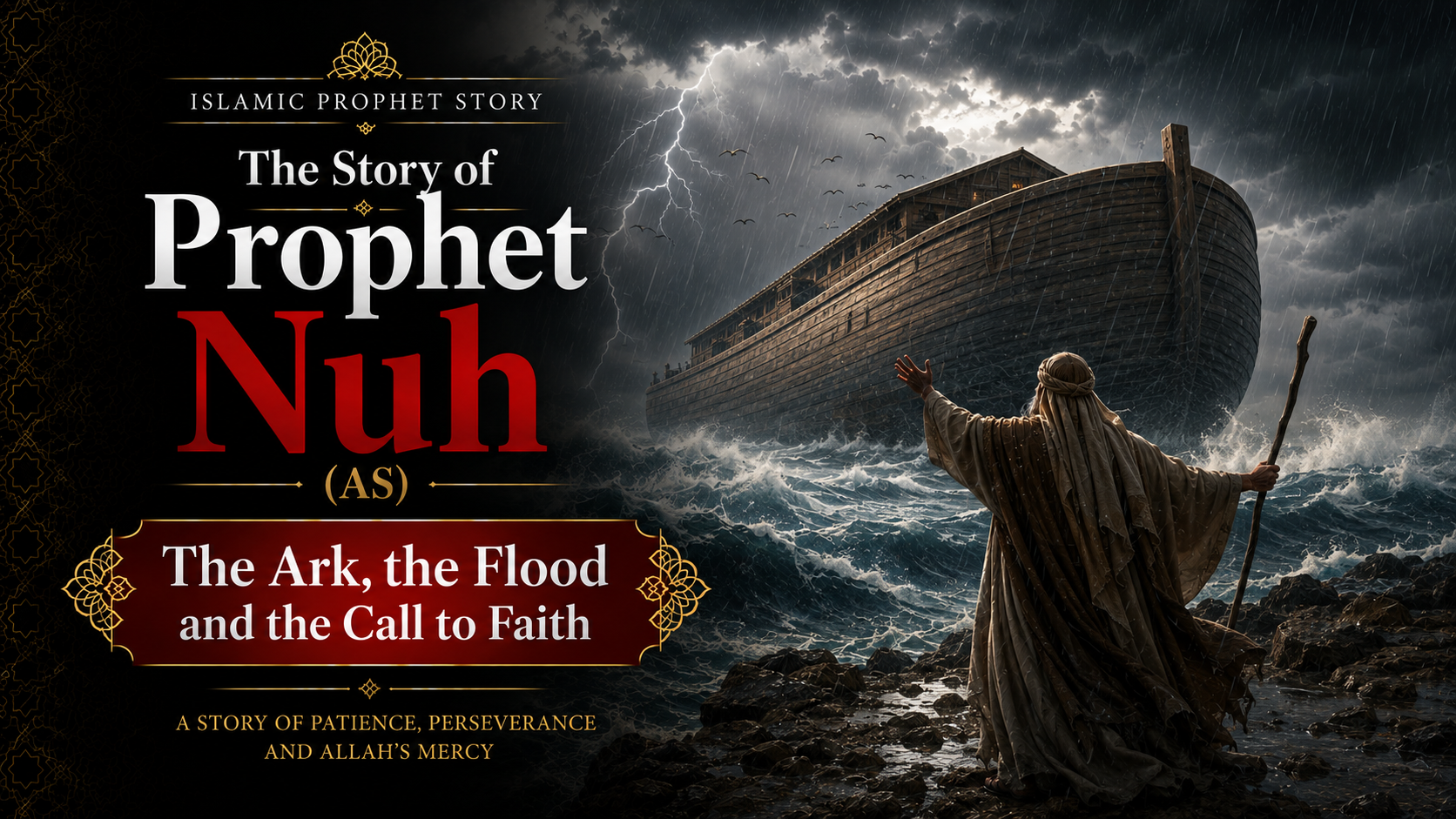
Nuh ibn Lamak ibn Mattushalakh (Noah, peace be upon him)
Prophet Nuh (peace be upon him) is the first of the Ulul Azm — the Messengers of supreme resolve — and the man whose mission of 950 years represents the longest recorded prophetic effort in Islamic history, conducted almost entirely without success in terms of human response, yet completed with absolute fidelity to the divine command. His story is the Quran's foundational account of human deviation from tawhid, the nature of divine forbearance before judgment, and the meaning of perseverance so deep it defies every ordinary human measure.
Antediluvian Pre-Islamic Prophetic Era · Circa 3000–2500 BCE (traditional reckoning, antediluvian era)
Before the flood, the earth was a different world. The descendants of Adam had multiplied across the land, and the generations that had maintained the pure monotheism of their first father had given way, over centuries of distance from the original revelation, to the worship of righteous men whose images had been gradually transformed into objects of devotion. Ibn Kathir records in Al-Bidayah wal-Nihayah, drawing on the narration in Sahih al-Bukhari from Ibn Abbas, may Allah be pleased with him, that the original idols of the people of Nuh — Wadd, Suwa', Yaghuth, Ya'uq, and Nasr — were the names of righteous men from the time between Adam and Nuh whose community had honored them with images after their deaths, and that Shaytan gradually inspired the people to worship those images.
It was to this world — a world that had drifted from tawhid not through sudden apostasy but through the slow accumulation of honored innovations — that Allah sent Nuh, peace be upon him, as a warner and a messenger, charged with calling his people back to the worship of the One who had created them and sustained them in a world that had already given them everything they needed if only they had eyes to see it.
Nuh, peace be upon him, was not a young man when his mission began — the classical scholars, drawing on the Quranic statement in Surah Al-Ankabut (29:14) that he lived among his people for nine hundred and fifty years, place his mission as spanning the vast majority of that extraordinary lifespan.
For nine hundred and fifty years, Nuh, peace be upon him, called his people to the worship of Allah alone. The Quran preserves in Surah Nuh (71:5–20) a remarkable first-person account of how he approached his mission — remarkable because it demonstrates not a single method but a sustained variety of approaches, calibrated with pastoral intelligence over centuries of effort. He told his Lord: 'I invited them day and night but my invitation only increased them in flight.
And indeed, every time I invited them that You might forgive them, they put their fingers in their ears, covered themselves with their garments, persisted, and were arrogant with great arrogance. Then indeed, I invited them publicly. Then indeed, I announced to them and whispered to them in private.' Public address, private counsel, gentle persuasion, clear warning — he tried every modality of prophetic communication that the tradition would later document as the legitimate means of calling people to truth.
He reminded them of the signs of Allah in the creation around them — the rains that caused the crops to grow, the rivers that sustained their lives, the stars by which they navigated, the arrangement of the heavens and the earth. His call was not abstract theology but an invitation to observe what was already in front of them and follow the evidence of divine wisdom in the fabric of the world they lived in.
The response of the people of Nuh is recorded in the Quran with a precision that captures the particular sociology of religious rejection. It was not the ordinary people who led the resistance — it was the chiefs, the leaders, the wealthy, the men of standing whose social position depended on the existing order of things. The Quran records in Surah Hud (11:27) their objection: 'We do not see you but as a man like ourselves, and we do not see you followed except by those who are the lowest of us in opinion.
And we do not see in you over us any merit; rather, we think you are liars.' Three accusations in one sentence: you are ordinary, your followers are the lowest class, and you have no advantage over us. The social logic of their rejection was transparent — to accept Nuh's message was to accept the equality of all human beings before Allah, which meant that the poor, the enslaved, the marginalized who had already responded to his call would be their spiritual equals, and perhaps their superiors.
The chiefs offered Nuh a deal: drive away the believers of low social standing who had followed you, and then we will consider your message. The Quran records in Surah Hud (11:29–31) Nuh's refusal with remarkable dignity: he would not drive away the believers, he did not know the unseen, he did not claim to be an angel, and he would not dismiss those whom Allah had honored with faith simply to make the comfortable more comfortable in their rejection.
The building of the ark is one of the most textured episodes in the entire Quranic narrative of Nuh's mission, not because the Quran gives technical detail about the ark's construction, but because of the social context in which that construction took place. The classical commentators, including al-Qurtubi and Ibn Kathir, describe Nuh building the ark in a place far from the sea or any large body of water — in a location that made the project look, to every observer, like the activity of a man who had lost his reason.
His people came and mocked him. They laughed at the spectacle of an old man building a massive vessel on dry land. The Quran records in Surah Hud (11:38) that every time the chiefs passed by, they ridiculed him — and Nuh, peace be upon him, said to them: 'If you ridicule us, then we will ridicule you just as you ridicule. And you are going to know who will get a punishment that will disgrace him and upon whom will descend an enduring punishment.' He continued building.
Allah had given him the command and the instruction — 'Construct the ship under Our eyes and Our inspiration,' Surah Hud (11:37) — and the years of mockery could not interrupt a project that had divine authorization. The ark rose plank by plank in the sight of the people who laughed at it, and each plank was itself a form of da'wah — the visible declaration that the man building it believed Allah's word more than he believed their laughter.
The sign that the time had come was precise and undramatic: the Quran records in Surah Hud (11:40) that the command came when the tannur — the oven, or in some classical interpretations a specific spring of water — began to gush. The flood was beginning. Nuh was told to take aboard a pair of every kind of creature, his family, and those who had believed — and the Quran adds, with the quiet weight of finality, that only a few had believed.
The boarding of the ark is followed immediately in the Quranic narrative by the episode that is perhaps the most personally devastating moment in the entire story of Nuh, peace be upon him. His son — referred to in the Quran as Ibn Nuh, whose name classical scholars, including Ibn Kathir, give as Kan'an — was not among those who boarded. As the waters rose, Nuh saw him at a distance and called out — as the Quran records in Surah Hud (11:42–43) — 'O my son, come aboard with us and be not with the disbelievers.' His son replied: 'I will take refuge on a mountain that will protect me from the water.' Nuh said: 'There is no protector today from the decree of Allah, except for whom He gives mercy.' And the wave came between them, and the son was among the drowned.
Nuh, peace be upon him, then called upon his Lord — in a prayer that the Quran records with the full weight of a father's grief — to save his son, for his son was of his family and the promise had been of family. Allah's response in Surah Hud (11:46) was one of the most sobering definitions of family in all of scripture: 'He is not of your family; indeed, he is of bad conduct.
So ask Me not for that about which you have no knowledge. Indeed, I advise you, lest you be among the ignorant.' The bond of faith had superseded the bond of blood. Nuh, peace be upon him, immediately sought Allah's forgiveness for the request — 'My Lord, I seek refuge in You from asking that of which I have no knowledge. And unless You forgive me and have mercy upon me, I will be among the losers' — a response that demonstrates the depth of his submission even in the moment of his greatest personal loss.
The flood covered everything. The Quran records in Surah Hud (11:44) the command that came when the judgment was complete: 'O earth, swallow your water, and O sky, withhold.' The waters receded. The ark settled on the mountain of al-Judi — identified by the classical scholars as a mountain in the region of present-day southeastern Turkey or northern Iraq. What emerged from the ark was the remnant of humanity from which all subsequent generations of the human race descended — a detail the Quran confirms in Surah Al-Saffat (37:77): 'And We made his descendants the remaining ones.' Every human being alive today is, in the Islamic understanding, a descendant of the believers who boarded the ark with Nuh, peace be upon him.
This makes his story not merely an ancient narrative but the origin story of the current human family — and makes the question of why the flood was sent a question about the origins of every civilization that has existed since. The flood was not the end of humanity. It was a reset — a mercy in the form of a destruction, clearing the ground for the planting of something new.
The legacy of Nuh, peace be upon him, in Islamic tradition is anchored in two inseparable truths: his patience was real, and his mission was complete. The Prophet Muhammad, peace be upon him, is recorded in an authenticated hadith in Sahih al-Bukhari describing the scene of the Day of Judgment when all of humanity will go from Prophet to Prophet seeking intercession, and Nuh will be among those approached. He is also honored in the hadith of the Mi'raj, where the Prophet, peace be upon him, met him in the second heaven — a station that places him at the beginning of the prophetic hierarchy that leads upward toward Ibrahim.
The surah that bears his name — Surah Nuh, the seventy-first chapter of the Quran — is a first-person account of his mission preserved entirely in his own words as he reported them to his Lord, a form of narration unique among the Prophets, giving his story an intimacy that feels unlike any other prophetic account in the scripture. His name is mentioned forty-three times in the Quran, and he is listed among the Ulul Azm — the five Prophets of supreme resolve: Nuh, Ibrahim, Musa, 'Isa, and Muhammad, peace be upon them all.
The enduring lesson of Nuh, peace be upon him, is one that strikes at the deepest anxiety of every person who has ever tried to do good and watched it fail to produce visible results: faithfulness is not measured by outcomes. Nuh called for nine hundred and fifty years. He used every method. He exhausted every approach. And the total number of believers who boarded the ark with him was, by every account in the classical tradition, a number that could be contained in a single vessel.
By every human measure of effectiveness, his mission was almost a complete failure. And yet Allah placed him among the five greatest Prophets who ever lived, called his patience exemplary, and preserved his words in the Quran with a reverence that no human standard of success could justify. The lesson is not that effort does not matter — Nuh's effort was immense and documented and praised by Allah Himself. The lesson is that the effort and the outcome are in different hands, and the hand that holds the effort is yours, and the hand that holds the outcome is Allah's. Be faithful with what is yours. Trust Allah with what is His.
Mafunzo kutoka kisa hiki
- Perseverance in the prophetic tradition is not measured in months or years but in absolute fidelity to the commission regardless of visible results. Nuh called his people for nine hundred and fifty years — longer than the entire recorded history of most civilizations — and the Quran's judgment on his life is not that he failed but that he was faithful. The believer who is discouraged by slow or absent results in their efforts for good should measure their work by the standard of fidelity, not the standard of immediate impact.
- The bond of faith supersedes every other bond of human loyalty when they are placed in direct competition. The drowning of Nuh's son is one of the most painful passages in the Quran, and Allah's response to Nuh's prayer for him is one of the most uncompromising: 'He is not of your family.' The believer must love their family with everything they have — and must also be clear that the deepest family is the family of those who share the submission to Allah, and that no family bond authorizes the compromise of divine truth.
- Mockery and ridicule from the powerful are not evidence that the truth-teller is wrong — they are, historically, a near-universal response to prophetic challenge. Every Prophet faced the same accusation: you are ordinary, your followers are beneath us, you claim what you cannot prove. Nuh continued building the ark in the sight of people who laughed at him. The Muslim who is ridiculed for practicing their faith or standing for an unpopular truth is in explicitly prophetic company.
Kuishi nayo leo
The story of Nuh contains a specific and sobering instruction for Muslims who are engaged in any form of da'wah — calling family members, friends, colleagues, or communities toward the truth of Islam. The natural human expectation is that sincere effort, sustained over enough time and conducted with enough skill, will eventually produce conversion. Nuh's story dismantles this expectation entirely and replaces it with something more sustainable: the task is to deliver the message faithfully, completely, and consistently, by every available means, and to leave the opening of hearts entirely to Allah.
This reframing is not a consolation for failure — it is a theologically accurate description of how the prophetic task has always worked. The Muslim who has been calling a parent, a sibling, or a friend to Islam for years without visible response is not doing something wrong. They may be doing exactly what Nuh did, and the only question that matters is: are they still building the ark?
The episode of Nuh's son also speaks directly to a painful reality that many Muslim families navigate: the presence within the family of someone whose choices place them outside the community of faith, whether through explicit rejection of Islam or through a life that is practically irreconcilable with the deen. The temptation is either to sever all connection out of religious principle or to accommodate the deviation out of family love.
Nuh's model is neither. He called his son to the last possible moment. He did not abandon the relationship before Allah's decree closed it. And when the decree came, he accepted it — grieving, but accepting, and immediately turning the grief into a prayer for his own forgiveness rather than a protest against divine judgment. For Muslims who love family members whose choices are in conflict with their faith, the model is: love all the way to the last moment, call with everything you have, and then place the outcome in the hands of the only One who can do anything about it.