

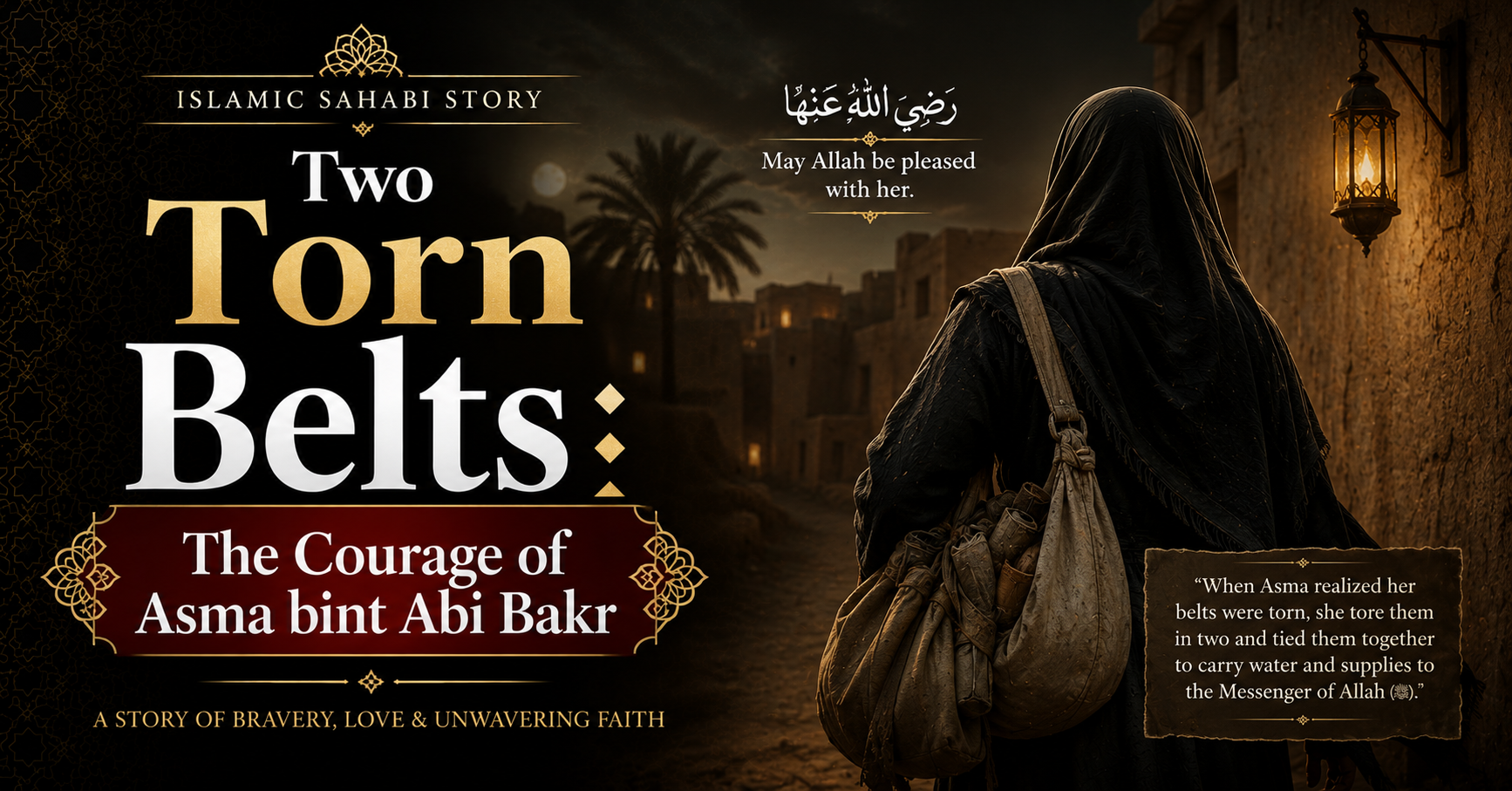
Asma bint Abi Bakr (Dhat al-Nitaqayn)
Asma bint Abi Bakr was the daughter of Abu Bakr al-Siddiq and elder sister of Aisha, best known for tearing her waist-belt in two to secure provisions for the Prophet ﷺ and her father during the Hijrah to Medina. She lived to over a hundred years old and, in her final days, urged her son Abdullah ibn al-Zubayr to face death rather than surrender his principles.
Meccan Period through Umayyad Era · Circa 595–692 CE
It was still dark when Asma bint Abi Bakr made her way carefully toward the outskirts of Mecca, carrying a bag of food and a container of water meant for two men hiding in a cave on Mount Thawr. Her father, Abu Bakr al-Siddiq, and the Prophet Muhammad ﷺ were fleeing Mecca under threat of assassination, beginning the migration that would become the Hijrah, the turning point of Islamic history.
When she reached the cave and prepared to hand over the supplies, she realized she had nothing to tie the bag closed with. Without hesitation, she untied the single belt around her waist and tore it into two strips, using one to secure the food bag and keeping the other to tie around herself. From that night onward, she was known among the Companions as Dhat al-Nitaqayn, the woman of two belts, a title of honor that followed her for the rest of her life.
Asma was the daughter of Abu Bakr, the closest companion of the Prophet ﷺ, and the elder sister of Aisha, the Mother of the Believers. Ibn Ishaq's Seerah and later biographical works record that she was one of the earliest converts to Islam, embracing the faith while still a young woman in Mecca during a period when doing so carried real danger. Her role during the Hijrah placed her at the center of one of the most perilous episodes in the Prophet's ﷺ life.
While her father and the Prophet ﷺ hid from Meccan search parties for three days in the cave of Thawr, it was Asma, along with her brother Abdullah ibn Abi Bakr, who maintained the vital link between the fugitives and the outside world, bringing news and provisions under constant risk of discovery.
Her courage during this period was tested directly by Abu Jahl, one of the fiercest opponents of the Prophet ﷺ, who came to her house demanding to know where her father had gone. Reports preserved in the classical sira literature describe how Abu Jahl, in his fury at not receiving an answer, struck her hard enough to leave a mark on her face, yet she refused to disclose any information about her father's whereabouts.
She was, at the time, several months pregnant with her son Abdullah ibn al-Zubayr, who would be born shortly after the migration to Medina and become the first child born to the Muhajireen in the new Muslim community, an event celebrated among the Companions as a sign of hope after the hardship of exile.
Asma's life did not slow after the Hijrah. She married Zubayr ibn al-Awwam, one of the ten Companions promised Paradise, and managed a household under conditions of real poverty in the early years of Medina, reportedly carrying date stones on her head from her husband's land for long distances because he owned no servant to help her, until Abu Bakr eventually provided her with assistance. Her endurance through this hardship, described in her own words in later hadith collections, reflects a woman who treated physical labor and sacrifice as simply part of building a life devoted to her family and her faith, without complaint recorded against her situation.
Her most remarkable moment, however, came in the final chapter of her extraordinarily long life. By the time her son Abdullah ibn al-Zubayr had become a rival claimant to the caliphate against the Umayyads and was besieged in Mecca by the forces of al-Hajjaj ibn Yusuf, Asma was reportedly around one hundred years old, blind, and near the end of her life. When Abdullah came to her, uncertain whether to continue resisting or to surrender and face likely humiliation, she told him firmly that death with honor and principle was better than a life bought through submission to tyranny, urging him to hold to what he believed was right until the end.
He was killed shortly after in the siege, and al-Hajjaj, in a further act of cruelty, had his body displayed publicly. When al-Hajjaj came to Asma afterward, seeking either her endorsement or her fear, historical accounts describe her responding to him with unshaken defiance, rebuking him for his brutality rather than pleading for mercy, even in her final days of life.
Asma bint Abi Bakr died shortly after these events, having lived through the entire arc of early Islamic history, from the persecution in Mecca, through the Hijrah, the building of the Medinan community, and into the political upheavals of the late seventh century. Her life spanned nearly the whole first century of Islam, and at every stage she is recorded as a woman of unwavering resolve, whether tearing her belt in the dark outside Mecca or standing unafraid before one of history's most feared governors.
The legacy she left behind was not simply the title Dhat al-Nitaqayn but a demonstrated model of what steadiness under pressure looks like across an entire lifespan. She is remembered not for a single act of bravery but for a consistency that never wavered from youth to old age, through poverty, threats, childbirth in exile, and finally the loss of her own son to political violence. Her story teaches that courage is not a trait exhausted by a single dramatic moment but a discipline renewed again and again whenever circumstances demand it.
Mafunzo kutoka kisa hiki
- Resourcefulness in service of a greater cause matters even in small, practical moments. Asma's decision to tear her own belt rather than fail to secure the Prophet's ﷺ provisions shows that devotion often expresses itself through quick, unglamorous problem-solving rather than only grand gestures.
- Withholding information under threat and refusing to betray those relying on your discretion is a real form of courage, one Asma displayed when struck by Abu Jahl yet still protected her father's location, demonstrating that loyalty can require enduring personal harm without yielding.
- Principle should not soften with age or personal cost. Asma's counsel to her son at the very end of her life, urging him toward honor over survival through submission, reveals that a life of conviction ought to remain consistent from youth through its final days.
Kuishi nayo leo
For Muslims today, Asma's willingness to sacrifice something of her own, even something as small as her belt, to serve a larger cause is a reminder that acts of devotion do not need to be extraordinary to matter. A practical application is to look for the small, unglamorous ways one can contribute to family, community, or faith commitments, rather than waiting for a dramatic opportunity to prove sincerity; consistent small sacrifices often build the same character that grand ones do.
Her refusal to break under threat, and her insistence on principle even in the final days of her life, also offer guidance for navigating pressure in modern contexts, whether workplace ethics, family disputes, or standing by unpopular but correct positions. A Muslim can apply this by resisting the temptation to compromise core values simply because pressure is applied or because age, fatigue, or fear makes silence easier, remembering that Asma's steadiness only grew firmer as she grew older rather than eroding with time.