

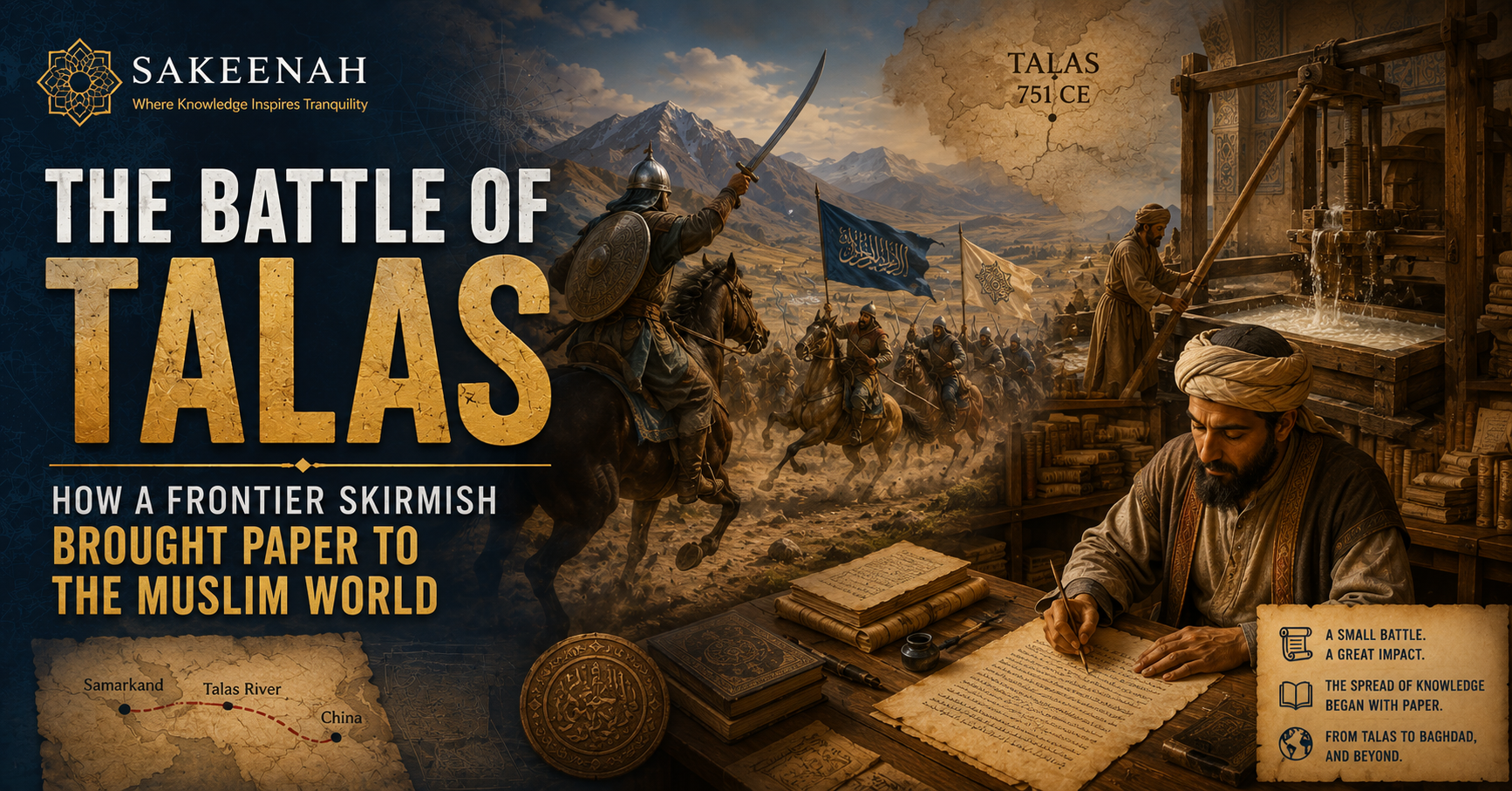
In the summer of 751 CE, along the Talas River in what is today Kyrgyzstan and Kazakhstan, an Abbasid army under the general Ziyad ibn Salih met a Tang Chinese force commanded by Gao Xianzhi. The battle itself lasted only a few days and was, by the standards of medieval warfare, a fairly contained frontier engagement fought over control of Transoxiana, the fertile lands between the Oxus and Jaxartes rivers.
Yet few battles in history have had consequences so disproportionate to their military scale. The Abbasids, aided by the defection of Karluk Turkic allies who abandoned the Tang mid-battle, won a decisive victory. Among the prisoners taken back toward Samarkand and Baghdad were, according to multiple early Islamic and Chinese sources, artisans skilled in the Chinese art of papermaking, a technology that had existed in China for centuries but had never spread west.
The eighth century was a pivotal moment for both civilizations meeting at Talas. The Tang dynasty was near the height of its westward expansion into Central Asia, while the Abbasid Caliphate, having just overthrown the Umayyads in 750 CE, was consolidating a new capital and a new political order that would soon be centered on Baghdad, founded by Caliph al-Mansur in 762 CE. Central Asia at this time was a contested crossroads of Turkic khanates, Chinese garrisons, Sogdian merchant cities, and expanding Muslim armies, all competing for the Silk Road trade that ran through Samarkand, Bukhara, and Kashgar.
The Karluks' decision to switch sides mid-battle reflected the fluid, shifting loyalties of these Central Asian frontier peoples, who often found more durable arrangements with the Abbasids than with a distant Tang court.
What happened after the battle mattered more than the fighting itself. Papermaking, which the Chinese had guarded as a closely held craft since its refinement under Cai Lun around 105 CE, spread rapidly once it reached Samarkand. By the 790s, a paper mill was operating in Baghdad itself, and within a century Muslim papermakers had improved on the Chinese techniques, using linen and hemp rags to produce a smoother, more durable sheet than the mulberry-bark paper common in East Asia.
From Baghdad, paper production spread to Damascus, Cairo, Fez, and eventually to Muslim Spain, where the paper mill at Xativa near Valencia became one of the first in Europe. Paper was dramatically cheaper and easier to produce than parchment or papyrus, and this alone reshaped how knowledge could be recorded, copied, and preserved.
The Islamic significance of Talas is best understood not as a story of conquest but as a story of transmission, a theme deeply woven into the early Muslim intellectual tradition. The same decades that saw paper spread across Abbasid lands also saw the beginning of the great translation movement centered on Baghdad's Bayt al-Hikma, the House of Wisdom, where Greek, Persian, and Indian texts on philosophy, medicine, astronomy, and mathematics were rendered into Arabic.
Cheap, abundant paper made this translation project logistically possible on a scale that would have been unthinkable using parchment, which required the skins of entire flocks of animals for a single large manuscript. Scholars such as al-Khwarizmi, whose work on algebra was written in this very era, and generations of hadith scholars compiling and cross-checking chains of narration, depended on the availability of an affordable writing medium to do work that required constant drafting, copying, and correction.
The impact on world history extended far beyond the Muslim world itself. Paper technology moved from the Abbasid lands into Byzantium and then into Christian Europe over the following centuries, arriving in Sicily and Spain through Muslim intermediaries before reaching Italy by the twelfth century and the rest of Europe by the fourteenth. The printing revolution associated with Gutenberg in the 1450s would have been impossible without cheap paper, and that supply chain traces directly back through Muslim Spain and Abbasid Baghdad to the prisoners taken at Talas three centuries earlier. In this sense, the battle sits at the head of a chain of transmission connecting Tang China, the Abbasid Caliphate, and Renaissance Europe.
Mainstream history curricula, when they mention Talas at all, tend to frame it narrowly as a limit on Chinese westward expansion or a footnote in the history of the Silk Road, rarely crediting the Muslim world's decisive role in refining and disseminating the technology further than China itself ever did. Chinese papermakers had kept the craft largely within their own borders for centuries; it was Muslim artisans and scholars who turned it into a civilizational tool, industrializing production and pairing it with a culture that placed enormous religious and intellectual value on the written word, from the preservation of the Qur'an to the meticulous chains of hadith transmission.
That pairing of technology and textual culture is precisely the kind of contribution that tends to be minimized in accounts that treat the Islamic Golden Age as a passive custodian of Greek learning rather than an active engine of innovation.
For Muslims today, the story of Talas offers a quiet but powerful lesson about how Allah places opportunity inside events that look, on the surface, like ordinary political or military struggles. A frontier skirmish that neither side considered particularly historic became the technological seed of centuries of scholarship, from Ibn Sina's medical encyclopedias to al-Biruni's astronomical tables, all recorded and multiplied on paper. It is a reminder that the ummah's greatest contributions have often come not from grand, self-conscious projects but from the willingness to receive, adapt, and refine what came from outside, echoing the Prophetic tradition of seeking knowledge even as far as China.
In an age preoccupied with who invented what first, the history of paper in the Muslim world is a case study in the value of transmission, humility, and the patient work of turning a borrowed tool into a civilizational achievement.