

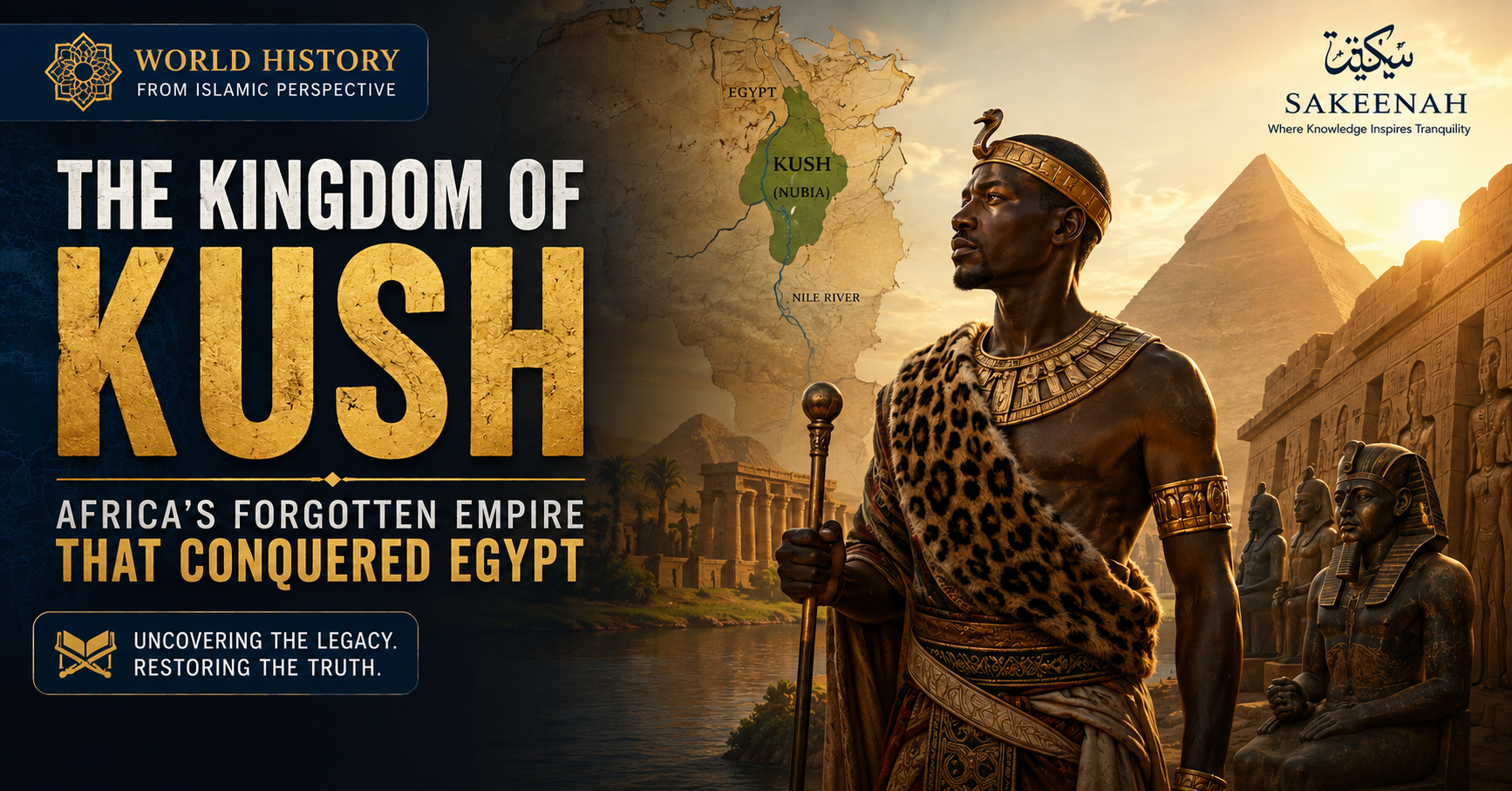
In 747 BCE, a king named Piye rode north from Napata — a city nestled beneath a sacred mountain in what is today northern Sudan — and did something that would have been unthinkable to the rulers of the Mediterranean world: he conquered Egypt. Not as a raider or a plunderer, but as a restorer. Piye, ruler of the Kingdom of Kush, was so devoted to the gods of Egypt, so deeply immersed in the religious traditions of the Nile Valley, that he wept when he saw the sacred horses of Hermopolis had been left to starve during the city's siege. He bathed in the Nile, offered elaborate prayers at the temples of Karnak, and then, having unified the entire Nile Valley from the mountains of sub-Saharan Africa to the shores of the Mediterranean, returned home to Napata — leaving his generals to administer the empire he had won.
The Kingdom of Kush had existed for centuries before Piye's conquest, flourishing in the region the ancient Egyptians called Nubia, stretching along the Nile from the first cataract near Aswan southward into the African interior. For much of its early history, Kush existed in complex relationship with Egypt — sometimes a vassal state, sometimes a trading partner, sometimes an adversary. The Kushites exported gold, ivory, ebony, and enslaved people northward, and absorbed Egyptian religious practice, art, and architecture in return. By the eighth century BCE, however, Egypt itself had fragmented into a patchwork of competing local dynasties, and it was the Kushite kings of Napata — more Egyptian in their piety than the Egyptians themselves — who saw an opportunity and a duty to reunify the ancient civilisation of the Nile.
Piye's conquest inaugurated what Egyptologists call the Twenty-Fifth Dynasty, and it endured under a succession of remarkable rulers. After Piye came Shabaka, who moved the capital to Memphis and issued a famous theological text, the Shabaka Stone, preserving ancient Egyptian cosmological traditions. Then came Taharqa, who reigned from approximately 690 to 664 BCE and is perhaps the most celebrated of the Black Pharaohs. Taharqa expanded Kushite influence into the Levant, forged alliances with the kingdoms of Judah and Israel against the rising Assyrian Empire, and undertook an extraordinary building programme, erecting temples, columns, and monuments from Kawa in Nubia to Karnak in Upper Egypt. His name even appears in the Hebrew Bible — in 2 Kings 19:9 and Isaiah 37:9 — where he is described as coming to the aid of King Hezekiah of Jerusalem against the Assyrian king Sennacherib around 701 BCE.
For Muslims, the significance of this era reaches far beyond architectural achievement. The land of Kush and Nubia is the same land to which the earliest Muslims would flee for refuge less than twelve centuries later. When the Prophet Muhammad (peace be upon him) sent the first migrants — among them Uthman ibn Affan and his wife Ruqayyah, daughter of the Prophet — to seek protection from the Negus of Abyssinia around 615 CE, they were travelling to a civilisational corridor that had been shaped, in part, by the legacy of the Kushite world. The justice, dignity, and protection that the Negus Ashama ibn Abjar extended to those early Muslims was not an accident of individual character alone — it was rooted in centuries of deep civilisational development along the Nile and the East African highlands. The land that sheltered the first Muslim refugees had once sheltered the traditions of one of antiquity's greatest empires.
The Assyrian invasions of 671 and 664 BCE ultimately drove the Kushite pharaohs back southward. Esarhaddon of Assyria sacked Memphis in 671 BCE, and his successor Ashurbanipal pushed further, sacking Thebes itself in 664 BCE — an act so devastating it shocked the ancient world. Taharqa and his successor Tantamani were forced to retreat to Napata, and the Twenty-Fifth Dynasty came to an end in Egypt. Yet Kush itself endured, and its civilisation continued to flourish. The capital eventually moved further south to Meroë, where a distinct Meroitic script was developed — one of Africa's earliest indigenous writing systems — and where iron smelting became so advanced that Meroë has been called the Birmingham of the ancient world. The kingdom survived, in various forms, until approximately 350 CE.
Mainstream history curricula, shaped heavily by Eurocentric frameworks, have long treated ancient Egypt as somehow separate from the broader African continent — a civilisation that belonged more to the Mediterranean world than to Africa. The story of the Kushite pharaohs directly dismantles that distortion. These were unambiguously African rulers, from cities deep in what is today Sudan, who did not merely interact with Egyptian civilisation but mastered it, preserved it, and ruled it at its full geographical extent. Moreover, the Kushite restoration of Egyptian religious and cultural traditions during a period of fragmentation represents one of history's more remarkable acts of civilisational conservation. Without the Twenty-Fifth Dynasty, it is plausible that much of what we associate with late-period Egyptian culture would have been lost or degraded far earlier.
For contemporary Muslims, the Kingdom of Kush offers a powerful corrective to the narrowing of historical imagination. Africa was not a blank canvas awaiting outside civilisation — it was home to empires of extraordinary sophistication, learning, and piety, centuries before Islam's arrival. When Muslims study world history, recognising Africa's ancient grandeur deepens our understanding of why the Prophet (peace be upon him) spoke so highly of the land of Abyssinia and its just ruler. It also reminds us that the ummah's roots stretch into soil far richer and more ancient than is often acknowledged. The Black Pharaohs of Kush built temples, governed justly, preserved knowledge, and faced down empires — a legacy every Muslim should know.