

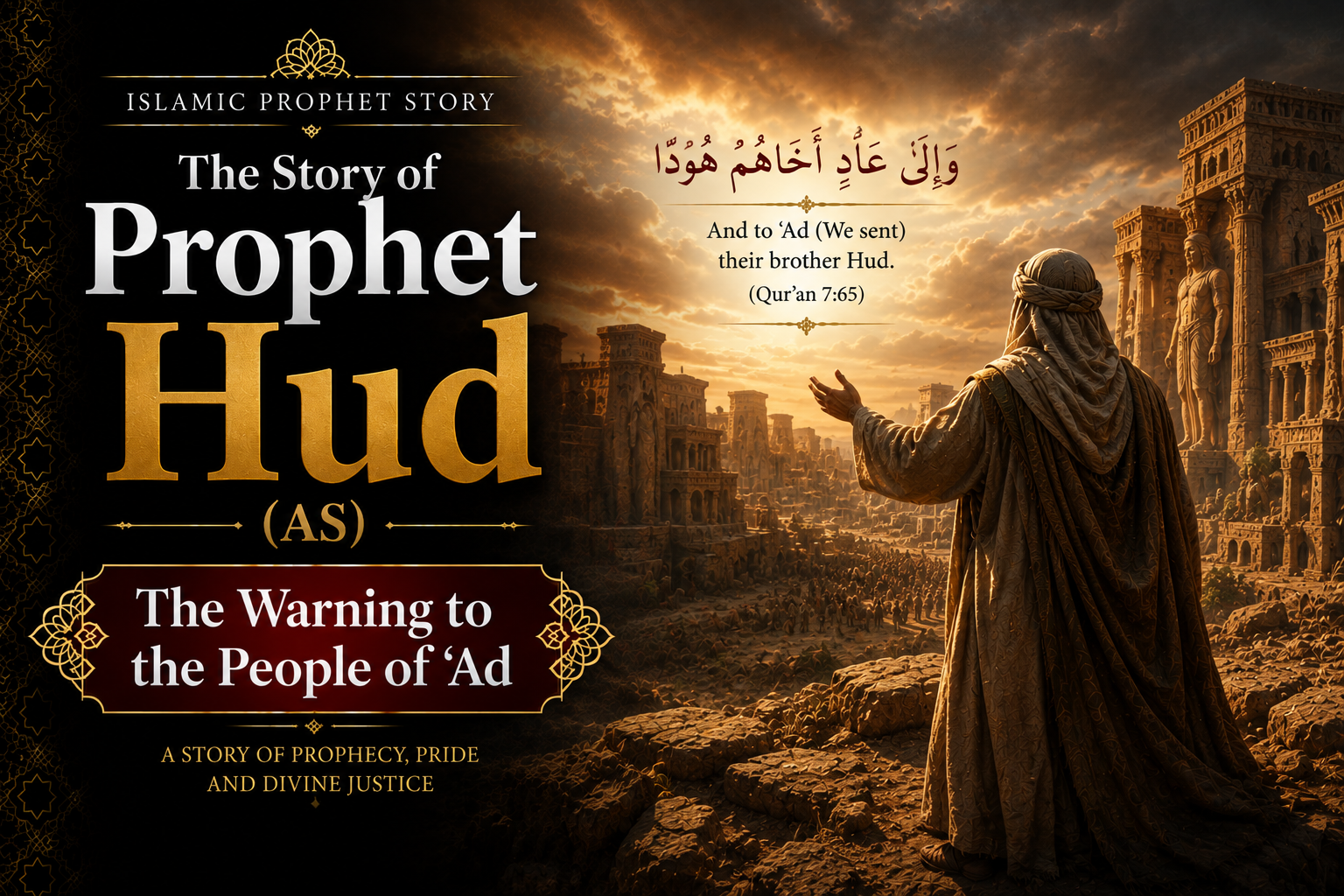
Prophet Hud (AS)
Prophet Hud (AS) was a noble messenger sent by Allah to guide the powerful and arrogant tribe of 'Ad. He is a descendant of Prophet Nuh (AS) and is known as the first Arab prophet, a steadfast warner who called his people to abandon their idols and return to the worship of the One true God.
The period following the Flood of Prophet Nuh (AS), in the ancient region of Al-Ahqaf in the Arabian Peninsula. · Circa 2300–2000 BCE (According to traditional Islamic chronology, after Nuh and before Ibrahim)
The sun blazed down on the sprawling city of Iram, a metropolis of towering pillars and formidable fortresses that the people of 'Ad had carved into the mountains of the Empty Quarter. They were a nation of giants, physically imposing, and masters of architecture, having built impressive monuments and homes hewn from the rocky hillsides to ensure their eternal legacy. Yet, for all their power, they had succumbed to a primal ignorance, bowing down to lifeless idols of stone and wood.
Their arrogance was a shield against reason, their wealth and might lulling them into a false sense of security and immortality. This was the state of affairs when a man from among them, a descendant of their forefather Nuh, was chosen by Allah to be a warner, a voice of truth in a wilderness of tyranny .
Into this world of immense power and deep-rooted polytheism stepped Hud (AS), a prophet who, according to classical sources, was the first to speak the Arabic language . He was a man of his people, known to them by lineage and character, yet his message was a profound challenge to the very foundations of their society. Hud (AS) implored his people to worship Allah alone, reminding them that they had no deity besides Him and that they were not meant to be mere inventors of falsehood .
He fearlessly addressed them, stating, 'My people, I am not a fool, but rather I am a messenger from the Lord of all the worlds. I deliver my Lord’s message to you, and I am a faithful counselor to you' . He sought no reward from them, clarifying that his recompense was only from the One who had created him .
Instead of heeding the call, the chiefs of the 'Ad scoffed. 'O Hud,' they retorted, 'you have not brought us any clear sign; we are not going to forsake our gods on your mere word, nor are we going to believe you' . They argued with him over the names of their idols, hollow titles with no divine authority. They saw no need for Hud's God when they were the strongest tribe on earth, having inherited the land after the people of Nuh and being endowed with strength and stature that seemed to confirm their own self-sufficiency .
In their defiance, they essentially threw his message back at him, accusing him of having been afflicted by the 'spell' of their gods . They were a people who had trapped themselves in a cycle of arrogance, believing that their material power and physical might would shield them from any consequence .
In a final, desperate appeal, Hud (AS) reminded them of the countless blessings Allah had bestowed upon them. He urged them to repent, a plea that was more strategic than desperate: 'My people! Ask forgiveness of your Lord and then turn to Him in repentance. He will send down to you abundant rain from the sky and He will add strength to your strength. Do not turn away as evil-doers' .
This was a direct counter to their arrogance, a warning that their power was not self-generated but a loan from the Divine, which could be withdrawn. But to the 'Ad, this was heresy. They had become so deluded that they challenged Hud to bring down the very punishment he promised. Their chief, in a final act of defiance, declared, 'We think you have been under the spell of our gods for calling them with bad names,' a testament to their complete intellectual and spiritual corruption .
Allah's decree was now sealed. Seeing no sign of faith from the people, Hud (AS) and his followers invoked Allah, putting their trust in their Creator against the arrogance of the 'Ad. Then, the sky changed. A wisp of cloud, small and seemingly insignificant, began to form on the horizon. The people, seeing it, rejoiced and thought it was a sign of rain coming to bless them. But they were woefully mistaken.
For seven nights and eight days, without interruption, a terrifying, icy hurricane of unparalleled fury was unleashed upon them . This was not the wind that fertilizes seeds; it was the wind that uproots nations. The source, as described in Islamic tradition, was a howling, freezing blast that tore their mighty structures apart, pulverizing their bodies and reducing their grand palaces to rubble as if they had never existed .
The 'Ad, the possessors of unimaginable power and architectural marvels, were annihilated. Only Hud (AS) and the few who had believed in him were spared, whisked away by Allah's mercy. The people, who had been 'more powerful than other men,' were rendered utterly powerless, their homes, their strength, and their civilization wiped from the face of the earth . The story of Prophet Hud (AS) serves as an unshakeable testament to a profound reality: that power, wealth, and physical strength are ephemeral.
Real power lies in the consciousness of Allah (taqwa) and obedience to His messengers. The legacy of Hud is a perpetual warning to every generation that no matter how sophisticated or powerful they become, they remain, and will always remain, utterly dependent on their Creator .
Lessons from this story
- Material strength and advanced civilization are no substitute for moral and spiritual integrity; they can even become a source of catastrophic arrogance that blinds one to the truth.
- True faith requires unwavering courage to stand against the dominant culture, even when it seems everyone else is wrong, and to deliver Allah's message with complete clarity and sincerity, asking no reward from people.
- Divine punishment is a reality for those who arrogantly reject clear warnings and persist in wrongdoing, while divine mercy is reserved for those who believe and place their trust in Allah alone.
Living it today
The story of Prophet Hud (AS) is a powerful reminder for Muslims today that worldly success—whether in the form of technology, economic power, or military might—does not immunize us from the consequences of moral failure. In our time, we see societies obsessed with progress and self-sufficiency, often marginalizing or openly mocking religious values. As a community, we are called to be 'warners' like Hud, promoting what is right and forbidding what is wrong, not by being confrontational and arrogant, but with clear, sincere, and wise counsel. We must not be intimidated by the perceived power of others, for that power is temporary and conditional, held only at the pleasure of Allah.
On a personal level, this story invites deep introspection about our own 'arrogance.' Are we ever dismissive of divine guidance because we feel our intellect, wealth, or status is sufficient? The lesson of Hud challenges us to re-evaluate our attachments—do we trust more in our bank accounts, our social positions, or our physical abilities than in Allah? Practically, this means consistently turning to the Quran and Sunnah as our primary sources of guidance, especially when they contradict our personal desires or the popular trends of society. It means cultivating humility by remembering that we, like the 'Ad, are ultimately small and dependent on Allah for our very breath and existence, and that nothing we have built is permanent.