

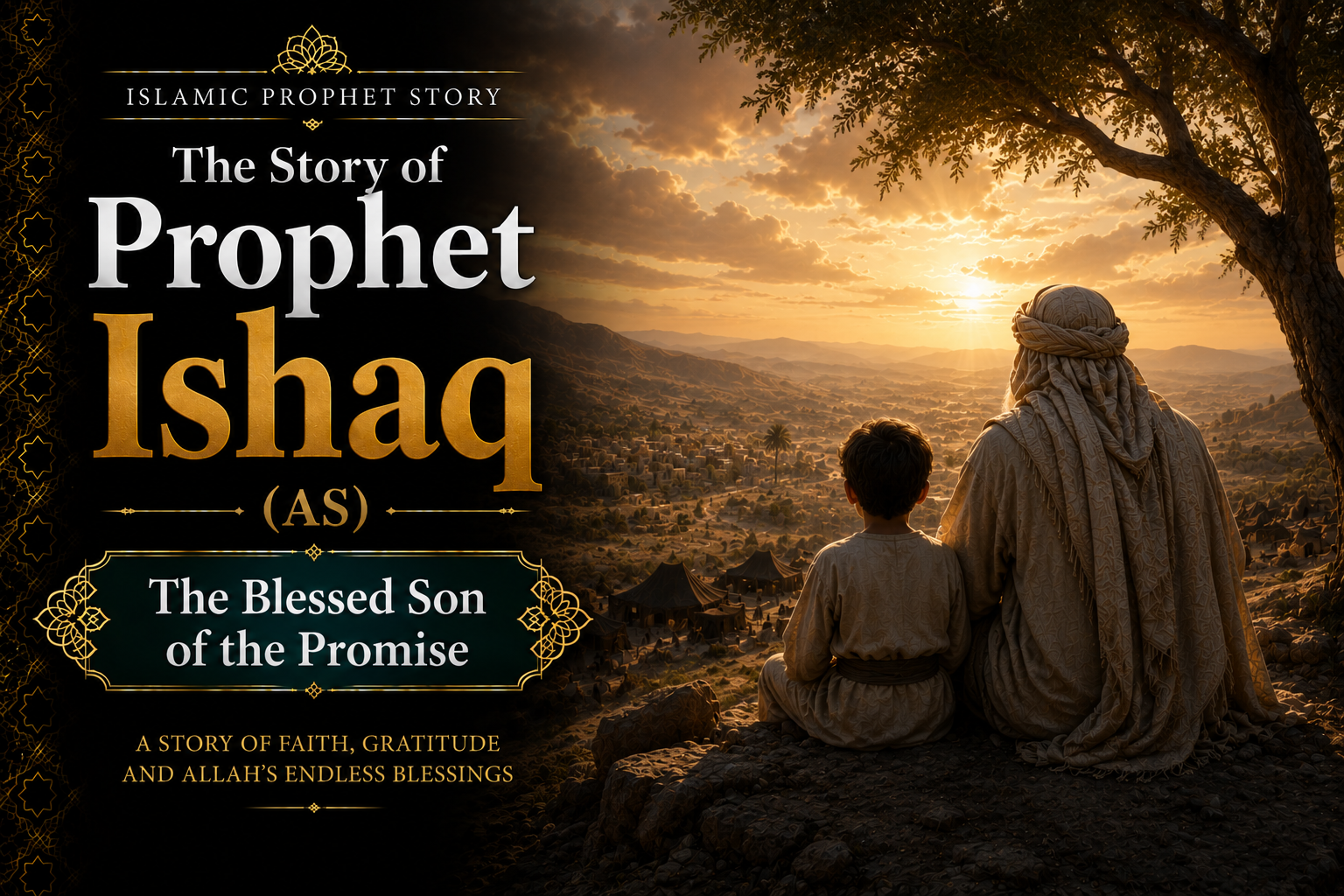
Prophet Ishaq (AS)
Prophet Ishaq (AS), the second son of Prophet Ibrahim (AS) and Sarah, was a prophet of Allah and a righteous man. He is a patriarch of the Bani Isra'il and the father of Prophet Ya'qub (AS), continuing the prophetic lineage and the divine covenant.
The era of Prophet Ibrahim (AS), in the land of Canaan (Palestine), where he succeeded his father as a prophet and patriarch. · Circa 1900–1800 BCE
The passage of time had taken its toll on the household of Ibrahim (AS). His wife Sarah, an elderly woman, had long resigned herself to a life without children. But the mercy of Allah is boundless, and His decrees are not bound by human limitations. One day, guests arrived at Ibrahim's home, men of a celestial bearing. As they dined, they delivered a message that would change everything: the birth of a son to the elderly Ibrahim and his barren wife Sarah .
Sarah, who was standing nearby, laughed in disbelief and perhaps in surprise, for who could imagine a miracle of such magnitude at such an advanced age? But the guests were not just ordinary men; they were angels of Allah, sent with a divine decree.
As the angels delivered their good news, they also gave a further prophecy: 'We give you the good news of a son, Ishaq, and after Ishaq, a grandson, Ya'qub' . This was not just the promise of a child but the promise of a legacy, of a prophetic lineage that would last for generations. It was a direct answer to the prayers of Ibrahim and Sarah, and a fulfillment of Allah's covenant.
Unlike the birth of Ismail, which was a blessing from Hagar, the birth of Ishaq was an even greater miracle, as it came from Sarah, a woman past the age of childbirth. The Quran declares him as a 'righteous servant,' a 'prophet of the righteous,' and his lineage would be the conduit for many other prophets, including Ya'qub, Yusuf, Musa, and Isa (peace be upon them all) .
Ishaq (AS) grew up as a blessed child, raised in the household of Ibrahim (AS), and he became a prophet after his brother Ismail's death . There is, however, a profound disagreement in the historical narrative regarding which son was nearly sacrificed. The Torah identifies Ishaq as the sacrificial son, while Islamic tradition and its strongest interpretations of the Quran support that it was Ismail . Nevertheless, both were prophets and both are honored in Islam.
Regardless of this historical discrepancy, Ishaq was a pivotal figure in the history of monotheism. He lived a life of piety, maintaining his father's religion based on Tawheed, and he was described as a man of 'Ikhlas' (purity of intention), who was strong and had great insight . He was, in every way, the worthy inheritor of the divine promise.
At the age of 40, Ishaq (AS) married a woman named Rafaqa (Rebekah), and she bore him two sons, 'Ais (Esau) and Ya'qub (Jacob) . As he grew older, Ishaq was guided by Allah to appoint Ya'qub, his younger son, as a prophet and his successor . This, in a way, mirrored his father Ibrahim's life, where the legacy was passed on. His story is not filled with the dramatic confrontations of other prophets; it is a story of steadfastness, of being the keeper of a sacred promise, and of ensuring that the light of prophethood continued to shine.
Ishaq lived a full life, passing away at an advanced age and being buried in Al-Khalil (Hebron) in Palestine, a city that holds immense significance for the Abrahamic faiths .
The legacy of Ishaq (AS) is immense. He is the father of the Bani Isra'il, the Israelites, from whom came a long line of prophets and messengers, including Musa (AS) and 'Isa (AS) . He is, therefore, a vital link in the chain of prophethood, the one who carried the torch from his father Ibrahim and passed it on to his son Ya'qub and his descendants. He was a man of immense patience and piety, a testament to the power of prophetic prayer and divine mercy.
His story teaches us that the promise of Allah is not just for a single person but for a lineage of believers, and that the greatest legacy we can leave behind is the legacy of faith, passed on from one generation to the next. His life was a testament to the beautiful continuity of the divine message.
Lessons from this story
- The promise and mercy of Allah are not constrained by human limitations; He can bring forth life and blessing from what seems impossible, and His timing is always perfect.
- A righteous legacy is the best inheritance; the value of one's life is measured by the faith and virtue one instills in their family, which continues to benefit them after they are gone.
- Being a 'blessed son of the promise' is not just about receiving an inheritance but about fulfilling the responsibility that comes with it, which is to live a life of righteousness and to guide others to the truth.
Living it today
The story of Prophet Ishaq (AS) is a profound lesson in the power of prayer and the importance of maintaining a legacy of faith. How often do we feel hopeless about our circumstances, thinking we are too old or our situation is too dire for things to change? The birth of Ishaq to Sarah teaches us to never lose hope in Allah's mercy and to constantly turn to Him in prayer. Our own 'barrenness'—whether it be a lack of children, material success, or spiritual fulfillment—can be transformed by His boundless grace. This story should encourage us to maintain a positive outlook and to trust that Allah can bring about miracles in our lives at any moment.
Furthermore, we are reminded of the importance of passing on our faith to our children. Prophet Ishaq (AS) was a result of his father's prayers and his success in raising a righteous son. The legacy of faith is not automatic; it requires intentional effort. In our families, we must strive to create a nurturing Islamic environment, teaching our children the Quran and Sunnah, not just as a ritual but as a way of life.
We must be role models of Islamic character, showing them what it means to be a Muslim in our daily actions and decisions. This means prioritizing our family's spiritual growth over material pursuits, and ensuring that the next generation inherits a stronger, more vibrant faith, continuing the beautiful chain of believers in the way that Ishaq (AS) continued the legacy of his father Ibrahim (AS).